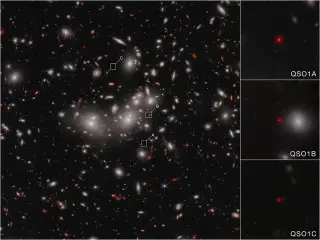
Black Hole Precedes Galaxy: Webb Finds Direct-Collapse Seed in the Early Universe
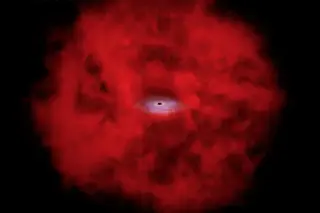
NASA’s James Webb Space Telescope observed Abell2744-QSO1, a highly lensed “Little Red Dot” from 700 million years after the Big Bang, revealing a ~50 million solar-mass black hole that accounts for about two-thirds of the system’s mass. The surrounding gas shows Keplerian rotation, allowing a direct mass measurement, which indicates the black hole formed before a substantial host galaxy—supporting primordial or direct-collapse seeds and challenging the idea that supermassive black holes grow primarily from stellar remnants within mature galaxies. Webb’s findings suggest such early, “pre-galaxy” black holes may not be rare and could reshape theories of black hole and galaxy co-evolution.