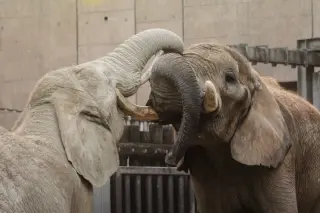
Elephants mimic play signals in sub-second timing to coordinate games
A study of 15 captive African savannah elephants found that when one elephant performed a distinctive trunk or head movement during play, a partner was more likely to reproduce that exact movement within one second. This rapid motor mimicry indicates a sub-second form of behavioral matching that may help coordinate vigorous play, distinct from slower contagion that spreads through a group. The effect was observed in a limited sample (eight elephants exposed to target movements) and did not establish broader emotional states like laughter; age, sex, and affiliation did not predict mimicry, and replication in more groups and wild populations is needed.