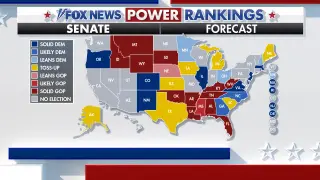
Fox News analyst Remy Numa’s latest Power Rankings project a 48-45 split in the Senate, leaving six races as toss-ups. Democrats could reach 55 seats on a strong night, while Republicans might retain control with 52. Trump’s approval has fallen to 36%, driven by Iran conflict and high gas prices, shifting key states like Ohio and Kansas toward Democrats.
A new Ipsos analysis of the Reuters/Ipsos Core Political survey, conducted October 22-26, 2026, reveals that Democrats hold a 9-point advantage over Republicans among likely voters for the 2026 generic congressional ballot. The data indicates 53% of likely voters favor or lean toward Democratic candidates, compared to 44% for Republicans. This shift correlates with a sharp decline in President Donald Trump’s approval ratings, with only 32% approving of his overall performance and just 25% approving of his economic handling. Public frustration with the cost of living has intensified, with only 20% approving of the administration’s approach to living costs. The Democratic party now leads on economic competence by 6 points, a significant reversal from the 17-point Republican advantage seen in January 2025. While Republican base support has softened, with fewer voters strongly approving of the president’s economic record, Democrats continue to show higher enthusiasm for voting in the upcoming midterms.
With eight days until the November 3 US midterm elections, Democrats are overwhelming favorites to seize control of the House of Representatives and strong contenders for the Senate. Nate Silver’s forecasting model assigns Democrats a 95% chance of winning the House and a 75% chance of the Senate. This projection is driven by President Donald Trump’s record-low net approval rating of -23.3, high inflation, and rising petrol prices. While Republicans retain a financial advantage, their candidates face a turnout crisis and voter dissatisfaction with the economy and the ongoing Iran conflict. Key battleground states like Texas, Ohio, and Michigan show tight races, but the generic ballot favors Democrats by 9.5 points.
A new CNN/SSRS poll shows Democrats leading Republicans by 10 points in congressional districts, driven by record-low approval ratings for President Trump and widespread economic dissatisfaction. While 75% of voters seek change, skepticism remains about whether a Democratic win will improve conditions, particularly among independents and Latinos.
With two weeks until the November 3 election, Democrats are strong favorites to win the House, but the Senate race remains tight. President Trump’s approval rating has dropped to 37%, driving a shift in competitive districts toward traditionally red states. While betting markets and polls favor Democrats, Republicans retain a significant financial advantage and are focusing on key Senate seats in states like Michigan and Ohio.
With two weeks remaining until the US midterm elections, multiple polls indicate President Donald Trump’s approval rating has reached a historic low, handing Democrats a significant lead in the race for Congress. Economic concerns, particularly inflation and rising gasoline prices linked to the ongoing conflict with Iran, are driving widespread voter dissatisfaction. While Republicans maintain a financial advantage in advertising, Democrats are favored to retake the House, with the Senate race remaining competitive. Turnout and the behavior of non-MAGA Republicans are critical variables in the final outcome.
A new AP-NORC poll reveals that 80% of Americans want substantial change or total upheaval in how the country is run ahead of the November 3 midterms. Economic concerns dominate voter priorities, with 85% citing the economy as a top issue. President Trump’s approval rating stands at 36%, with 79% disapproving of his handling of the cost of living. Democrats currently lead in likely voter polls, though the margin has narrowed slightly from previous weeks.
President Donald Trump faces a steep decline in popularity ahead of the November midterms, with new surveys showing his approval rating at historic lows. Voters express deep dissatisfaction with his handling of the economy, inflation, and the Iran conflict. While Republican party loyalty remains high among some base voters, enthusiasm for the party is waning, particularly among younger and Hispanic supporters, raising fears of significant losses in Congress.
Republican voters are increasingly disengaging ahead of the 2026 midterms, with polls showing a significant enthusiasm gap compared to Democrats. Trump’s approval rating has dropped to 30%, and young men, a key 2024 coalition, are frustrated by foreign policy and cost-of-living issues. Democrats are leveraging this apathy, raising record funds and targeting state legislatures, while Republicans struggle to mobilize support in swing states like Pennsylvania and Maine.
With less than a month until the US midterm elections, President Donald Trump faces a historic low approval rating of 32%, the lowest since 1952. Polls indicate Democrats hold a double-digit lead on the generic ballot, driven by voter dissatisfaction with rising inflation, the Iran conflict, and high energy costs. While Republicans retain a significant financial advantage, analysts predict a likely loss of the House majority and potential Senate losses, marking a potential 'blue tidal wave' for Democrats.
With four weeks until the US midterm elections, polling data indicates the Republican Party is facing a severe electoral setback. President Trump's approval rating has dropped to a record low of 32%, driven by high costs of living and the ongoing conflict with Iran. Analysts predict Democrats will gain between five and 13 House seats, while the Senate race remains competitive but leans Democratic. Key battlegrounds include Iowa, Texas, and Michigan, where economic frustration is eroding support among traditional GOP voters. Despite these numbers, some Republican strategists argue that polls are unreliable and that mobilizing the base could still yield a better outcome than expected.
With less than six weeks until the November midterms, multiple polls indicate a significant shift in voter sentiment against President Donald Trump. A Marist University survey found that 45% of registered voters view their upcoming vote primarily as a rejection of the president, while an NBC News poll reported a record 43% of voters seeking to send a signal of opposition. This anti-Trump sentiment coincides with a widening Democratic lead in generic congressional ballots, with Democrats holding a 12-point advantage in the Marist poll. Trump’s approval rating has dipped to 39% in the latest Marist data, though other surveys show lower figures, reflecting a hardened electorate that is increasingly focused on economic costs and foreign policy mismanagement.