The US administration has excluded the UK, France, and the Baltic states from a select NATO working group meeting in Poland, raising concerns about alliance fragmentation.
The Pentagon is expanding the U.S. nuclear arsenal to provide President Trump with more limited strike options, a move that has gone largely unnoticed by the media despite being disclosed to the Senate. Undersecretary of War Elbridge Colby argues that these new capabilities, including lower-yield bombs and sea-launched missiles, are necessary to deter threats from Russia, China, and Iran without resorting to total annihilation. While the Senate Armed Services Committee has been briefed, public debate remains absent, raising concerns about democratic oversight of nuclear policy.
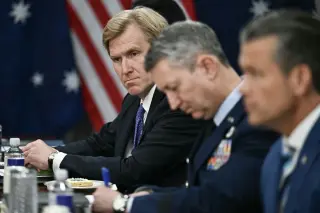
The Trump administration is excluding major allies, including the UK, France, and Baltic states, from a Pentagon-led NATO working group in Poland. This exclusion follows Washington’s recent threats to penalize allies not meeting defense spending targets, raising concerns about alliance cohesion amid Russian aggression.
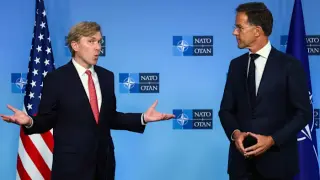
Pentagon policy chief Elbridge Colby has sharply criticized European NATO allies for failing to close critical military capability gaps, describing the alliance's assessments as a 'sea of red.' During a meeting in Brussels, Colby urged nations like the UK to accelerate procurement of US-made weapons, warning that Washington is reviewing its European troop presence to prioritize the western hemisphere and Asia. While the US demands a 'lasting' European defense model, European capitals fear the review will be used to punish laggards, though some allies pushed back by highlighting areas where they meet targets.
The US is conducting a six-month Europe Force Posture Review to reduce its conventional military footprint in Europe, aiming to transition to a 'NATO 3.0' model where Europe handles conventional defense while the US retains nuclear and strategic roles. Defense Secretary Pete Hegseth and Under Secretary Elbridge Colby are evaluating options to cut troops, aircraft, and naval assets, with a decision expected by November 6. European allies are accelerating defense spending and joint procurement to fill the resulting gaps, though significant dependencies on US command, intelligence, and missile defense remain.
U.S. Under Secretary of War for Policy Elbridge Colby has urged Asian allies to increase defense spending, framing the move as a return to 'flexible realism' rather than a retreat. While the administration emphasizes a strong U.S. presence in the Indo-Pacific, it expects partners to shoulder more of the burden. Concurrently, the U.S. Coast Guard has deployed six fast-response cutters to Singapore and the Philippines to bolster maritime security against Chinese activities in the South China Sea.
U.S. Under Secretary of Defense for Policy Elbridge Colby is unable to secure a Chinese invitation to visit Beijing, a move that highlights the fragility of U.S.-China defense ties. Beijing’s refusal appears linked to anger over a recent $11 billion U.S. arms sale to Taiwan and Colby’s history as a China hawk. While the Trump administration seeks to de-escalate tensions through trade and military channels, conflicting signals from Washington have complicated diplomatic efforts. Colby’s blocked visit underscores the difficulty of establishing high-level dialogue amidst ongoing strategic competition and internal U.S. policy shifts.
The Vatican rejected media claims that Cardinal Christophe Pierre, the pope’s U.S. representative, was given a “bitter lecture” during a January Pentagon meeting with U.S. defense officials, saying the encounter was a normal, cordial exchange. The Department of Defense described the meeting as substantive and respectful, noting discussions on morality in foreign policy and other topics, while the U.S. ambassador to the Holy See echoed Pierre’s account of a frank but courteous meeting.
Pentagon policy chief Elbridge Colby told senators that the U.S.-Israel campaign against Iran is not an endless war or regime change, arguing it’s a targeted action that fits within a refreshed national defense strategy prioritizing homeland and Western Hemisphere defense and encouraging allies to do more, while Democrats question the messaging and Republicans seek congressional oversight on further attacks.
Elbridge Colby, a rising star in the Republican Party, is leading an insurgent wing rebelling against decades of dominant interventionist and Reaganite thinking. Colby believes that China is the principal threat abroad and that the United States should focus on Asia to the near-exclusion of everywhere else, including Russia and Ukraine. He is part of the mounting revival of the Asia First doctrine that the party championed in the aftermath of World War II. Colby's views are advancing with lightning speed, and he is making appearances in influential settings.