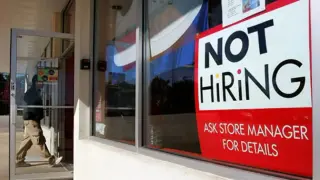
The US unemployment rate has fallen below 5%, nearing a historic low not seen since the mid-1960s. This decline indicates a tightening labor market and robust economic activity, though it may also signal rising inflationary pressures. The data reflects sustained job growth and low joblessness, marking a significant shift in the current economic cycle.
In the UK, employers may ask about current salary, but candidates are not legally required to answer. While the EU is banning such questions, the UK lacks similar legislation, relying instead on voluntary guidelines and pay transparency in job ads.
The US economy added only 29,000 jobs in September, far below the 84,000 expected, while the unemployment rate rose to 4.2%. Wage growth slowed to a five-year low, and previous months' job figures were revised downward. Despite the weak labor data, markets rallied as traders bet the Federal Reserve will hold interest rates steady in October.
The US economy added only 29,000 jobs in September, far below the 84,000 forecast, while the unemployment rate rose to 4.2%. Wage growth slowed to a five-year low, and markets rallied as traders bet the Federal Reserve will hold interest rates steady in October.
The Bureau of Labor Statistics releases the September nonfarm payrolls report on Friday, with economists expecting 84,000 to 94,000 new jobs and a stable 4.1% unemployment rate. While the labor market shows signs of stabilization, wage growth is slowing while inflation remains elevated, creating a complex dilemma for the Federal Reserve. Market expectations for an October rate hike have fluctuated sharply this week, currently sitting near 37%, as policymakers weigh the need to address persistent price pressures against a cooling but not collapsing job market.
U.S. job openings fell to 7.1 million in August, marking the lowest level since the spring. Despite this decline in available positions, the labor market remains resilient, with hiring and layoff rates staying low and stable.
US job openings have fallen to their lowest level since spring, while hiring and layoffs remain stagnant. This 'low hire, low fire' dynamic indicates a labor market that is neither expanding nor contracting rapidly, with businesses maintaining cautious staffing levels.
New economic data presents a split picture on AI’s impact on new graduates. While a CESifo study finds no significant rise in overall unemployment for recent college graduates, a Census Bureau report indicates that students in AI-exposed majors face lower initial employment rates and reduced earnings. These findings contrast with earlier Stanford research and highlight a growing divide between aggregate labor trends and specific sector vulnerabilities.
Starbucks is closing six locations in the Sacramento area as part of a broader plan to shut 250 North American stores. The move, announced on September 24, 2026, affects approximately 1% of the company's total locations and follows a previous wave of closures in 2025.
Garry Tan, CEO of Y Combinator, said he would “do nothing” about AI model distillation by open-source competitors, arguing regulators should aim for a balance that preserves open-weight models for access while frontier models retain a price premium. He downplays near-term existential risks, urges emphasis on current cybersecurity threats, and expects AI-driven job disruption to unfold over decades. The discussion underscores a preference for science fact over science fiction and highlights ongoing legal questions around training data.
The U.S. added 162,000 jobs in August, beating forecasts, with the unemployment rate holding at 4.1% and June–July gains revised up by 55,000, underscoring ongoing labor-market resilience (led in part by restaurants and bars).
ADP said U.S. private payrolls rose by 38,000 in August, the slowest pace in seven months and below the roughly 47,000 consensus, with gains concentrated in healthcare and also seen in construction and finance, signaling a choppy labor market ahead of the official BLS release.
Meloni frames her government as delivering a record jobs surge (historic low unemployment and about 1.2 million new stable jobs), crediting business-friendly policies, but critics say productivity and structural reforms lag, leaving the economy and public services with persistent problems; her moderation could invite conservative rivals as she pursues a long-term five-year term.
The Department of Labor identifies 13 careers that combine rapid growth with six-figure pay, spanning healthcare (e.g., nurse practitioners around $132K and physician assistants near $136K) and tech (data scientists about $120K, information security analysts about $129K, computer/information research scientists about $140K), plus engineers and medical researchers. Healthcare is expected to add the most jobs through 2035, with roughly 2.2 million new positions and 37% of all new roles, while overall growth remains strong in both health services and related fields.
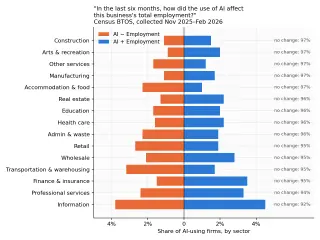
Census data tracking AI use in U.S. firms shows a jump from about 3.7% using AI in 2023 to roughly 18% using AI in any function by early 2026, yet the measured effect on total employment remains minimal: in late 2023–early 2024, 2.8% of firms reported employment increases and 2.6% decreases (94.6% unchanged); in late 2025–early 2026, 2.3% reported increases and 2.0% decreases (95.7% unchanged). Adoption is still concentrated in the minority of firms, and information-sector activity shows more variation. Among adopters, 44% say AI augments existing work, 10% say it performs tasks humans used to do, and 11% introduce new tasks; generative AI use centers on writing/emails (85%), information search (about 50%), summarizing (45%), and coding (13%). Most firms (64%) made no changes to operations to deploy AI; 15% trained staff, another 15% redesigned workflows, and ~1% hired AI-skilled workers. The share of firms where AI replaced a large or moderate share of tasks is still small, suggesting AI-driven employment disruption is not yet evident, consistent with the authors’ prior views.