Physicists built a 24,000-atom isolated quantum system that behaves like a tiny universe, showing time can emerge from internal entropy changes rather than an external clock—the enigmatic "entropic time"—and maintain standard quantum dynamics, offering a controlled testbed for quantum cosmology and gravity research.
A University of Birmingham team used a Bose‑Einstein condensate split into two halves to emulate a universe with no external clock. By letting entropy flow between the halves, they defined an internal clock—entropic time—that ordered events in the bright sector and could run faster, slower, or stop altogether as entropy exchange varied. The researchers also derived a Schrödinger equation using this internal time, supporting the idea that time and its arrow may emerge from internal relations and observer ignorance rather than an external time parameter.
New theoretical ideas suggest time may emerge from gravity via Shape Dynamics, while open quantum systems could host two arrows of time; other approaches explore time as potentially emergent or even illusory, with concepts like tachyons and quantum entanglement hinting at multi-dimensional or timeless frameworks.
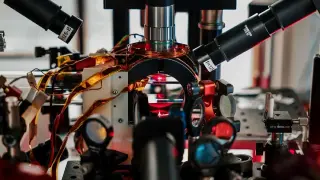
Physicist Giovanni Barontini built a lab-sized ‘mini-universe’ by cooling ~24,000 rubidium atoms into a Bose-Einstein condensate and trapping them in a two-region optical setup. The atoms’ movement between a bright (observed) and a dark (unobserved) sector creates entropy exchange that defines an internal, emergent time—time that flows due to entropy rather than an external clock—offering experimental insight into time in quantum gravity and cyclic cosmology.
A University of Birmingham team built a sealed quantum system of 24,000 ultracold rubidium atoms that mimics a tiny expanding/contracting universe and found that the flow of time can arise from internal entropy changes rather than an external clock. The experiment demonstrates entropic time, provides experimental support for time as a derived property in some quantum gravity theories, and shows the Schrödinger equation can be expressed with entropic time, offering a new laboratory testbed for quantum cosmology and gravity ideas.
Physicists modeling collapsing neutron stars find that, under extreme gravity, entropy could decrease in their equations, effectively implying time might run backward in that context—a mathematical insight into the arrow of time rather than a real, observable reversal.
New research reexamines the Boltzmann brain paradox, arguing that our memories and the arrow of time arise from assumptions about the past; the team offers a framework that separates physical laws from interpretive choices to better assess whether memories reflect a real history.
Physics says when you die, your atoms don’t vanish; they disperse into soil, air and other living systems, while the pattern that defined you—the brain’s arrangement of those atoms—unravels as energy flow ceases. Memories and personality are tied to this arrangement, not to any single atom, so personal identity ends even as matter persists and recycles throughout the universe.
Robert Hazen and Michael Wong argue that evolution is a universal process, not limited to biology, governed by a new natural law—the law of increasing functional information—that explains how complex systems from minerals to AI become more patterned as they generate and select for functional configurations. They describe a “second arrow” of time toward greater order despite entropy, outline three sources of selection (static persistence, dynamic persistence, novelty generation), and introduce functional information as a measure (based on Szostak). The concept has broad applications—from cancer to ecology and AI—and invites reflection on meaning and purpose within science, while highlighting humanity’s ability to accelerate evolution by imagining and testing countless configurations.
Physicists propose the Boltzmann Brain hypothesis: given enough time, random fluctuations could create a brain with all your memories, making our recollections potentially illusory. In a paper in Entropy, lead author David Wolpert and co-authors Carlo Rovelli and Jordan Scharnhorst argue this is a plausible consequence of physics, though there’s no rigorous way to prove or disprove it. They connect the idea to thermodynamics and argue that grounding our sense of time still rests on the Big Bang, concluding we shouldn’t panic, but the notion challenges the reliability of memory as a reflection of past reality.
A new theory by physicist Ginestra Bianconi suggests gravity may emerge from entropy, potentially reconciling Einstein’s general relativity with quantum theory. By treating spacetime as a quantum operator and describing an entropic action that couples matter to geometry through a G-field, the framework aims to yield a small cosmological constant and offer a candidate explanation for dark matter. While intriguing, the idea remains speculative and requires substantial further work to confirm its viability as a unified theory of physics.
A new study reveals a universal mathematical equation that describes how objects break apart in a way that maximizes disorder, applying to various materials and explaining the consistent size distribution of fragments when objects shatter.
University of Seville professor José María Martín-Olalla has resolved a 120-year-old thermodynamics puzzle by demonstrating that Nernst’s theorem is inherently linked to the second law of thermodynamics, correcting a long-standing assumption made by Einstein and reframing the understanding of entropy near absolute zero.
The article discusses a theoretical proof suggesting that Artificial General Intelligence (AGI) may be mathematically impossible due to entropy behavior in complex decision spaces, specifically in heavy-tailed semantic contexts, challenging the feasibility of fully autonomous, human-like AI systems.
The article explores the idea that gravity might be an emergent phenomenon driven by entropy increase, similar to effects seen in granular physics and thermodynamics, but this remains a minority and speculative view in physics, requiring more experimental evidence and testable predictions.