
Tag

Gastrulation

All articles tagged with #gastrulation

Two Developmental Tracks Forge the Human Brain, New Study Finds
science22 days ago

Two Developmental Tracks Forge the Human Brain, New Study Finds

Stanford-led research in Nature Neuroscience shows the brain develops from two collaborating progenitor cell types that create forebrain/midbrain and hindbrain in parallel, a split seen in mouse gastrulation and confirmed in human pluripotent stem cells differentiating into neural ectoderm. The forebrain/midbrain lineage marks the gene Otx2, while the hindbrain lineage marks Gbx2, and the two lineages have distinct chromatin landscapes, suggesting non-interchangeable roles. The study implies the brain’s two-part origin may reflect an ancient evolutionary split and could inform brainstem disease research.

Mechanical Forces and Evolutionary Strategies in Tissue Development
biology1 year ago

Mechanical Forces and Evolutionary Strategies in Tissue Development

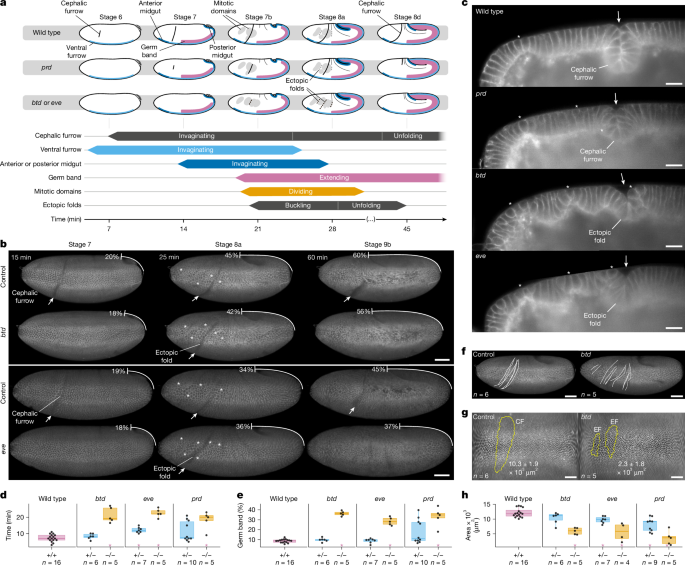
The study reveals that the cephalic furrow (CF) in fly gastrulation is an evolutionary innovation in Cyclorrhapha that functions as a mechanical sink to prevent tissue collision and buckling during head and trunk expansion. In non-cyclorrhaphan flies, alternative strategies like out-of-plane cell division mitigate mechanical stress, highlighting divergent evolutionary adaptations to ensure robust morphogenesis. Loss of CF leads to tissue buckling and developmental defects, emphasizing its mechanical and developmental importance.

Mechanical Forces and Evolutionary Strategies in Gastrulation and Organ Development
biology1 year ago

Mechanical Forces and Evolutionary Strategies in Gastrulation and Organ Development

The study reveals that the patterned invagination of the cephalic furrow in Drosophila prevents mechanical instability during gastrulation by absorbing compressive stresses caused by mitotic domains and germ band extension, with its formation regulated by specific gene expression patterns, and suggests that mechanical challenges have driven the evolution of this morphogenetic feature in dipteran flies.