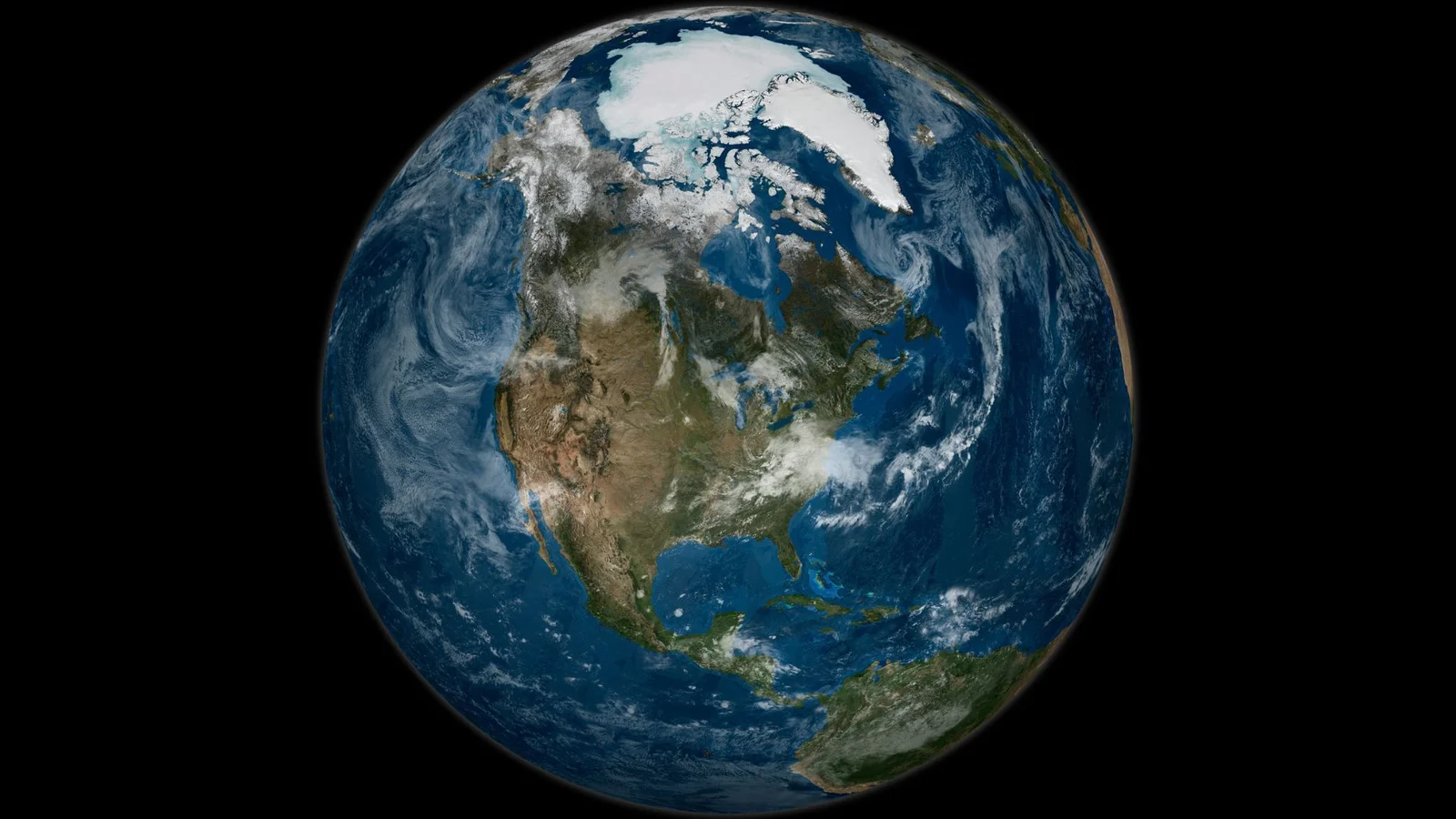
A new study reveals that Earth's solid surface is becoming less flattened at the poles while its gravitational field is becoming more flattened, driven by accelerating ice melt and mass redistribution.
A March 26, 2026 NASA ISS image of the James Bay Lowlands shows land rebounding after the Laurentide Ice Sheet, with beach ridges forming along the shore, vast peat bogs, and other glacial features as the surface rises about 10 mm per year near Hudson Bay and sea ice breaks up in late spring.
New research ties climate-change–driven sea-level rise to a record-fast lengthening of Earth's day: about 1.33 milliseconds per century today, with warming scenarios predicting up to 2.62 milliseconds per century by 2080. While the Moon’s gravity, glacial rebound, and winds modulate the effect, the human-caused signal is growing; past day lengths were inferred from fossil foraminifera. The current rate is among the fastest in 3.6 billion years and could affect precise timekeeping and spacecraft navigation in the future.
New York City is sinking at an average rate of 0.06 inches per year, according to a study by NASA's Jet Propulsion Laboratory. While some sinking is due to natural glacial isostatic adjustment, human activity, such as landfills and groundwater pumping, is also contributing to the sinking. The study also identified areas of uplift, where the land is rising. Further research will continue to investigate surface displacement globally, providing valuable data for planning in the face of sea level rise.