
Tag

High Redshift Galaxies

All articles tagged with #high redshift galaxies

JWST Spots Mature, Chaotic Galaxies in the Early Universe, Forcing Revisions to Early Formation Models
science9 days ago

JWST Spots Mature, Chaotic Galaxies in the Early Universe, Forcing Revisions to Early Formation Models

JWST observations of galaxies formed within the universe’s first billion years reveal unexpectedly massive, non-rotating, and dust-rich systems with chaotic morphologies. These findings strain the standard Lambda-CDM prescriptions for early star formation efficiency, feedback, and assembly, suggesting the need to revise the models rather than overturn the overall cosmology. Spectroscopic follow-up and updated cosmological simulations are underway to identify which parameters (star-formation efficiency, IMF, dust corrections, etc.) must be adjusted, while Lambda-CDM itself remains intact at large scales.
Webb Spots MoM-z14: A Bright Beacon 280 Million Years After the Big Bang
space3 months ago

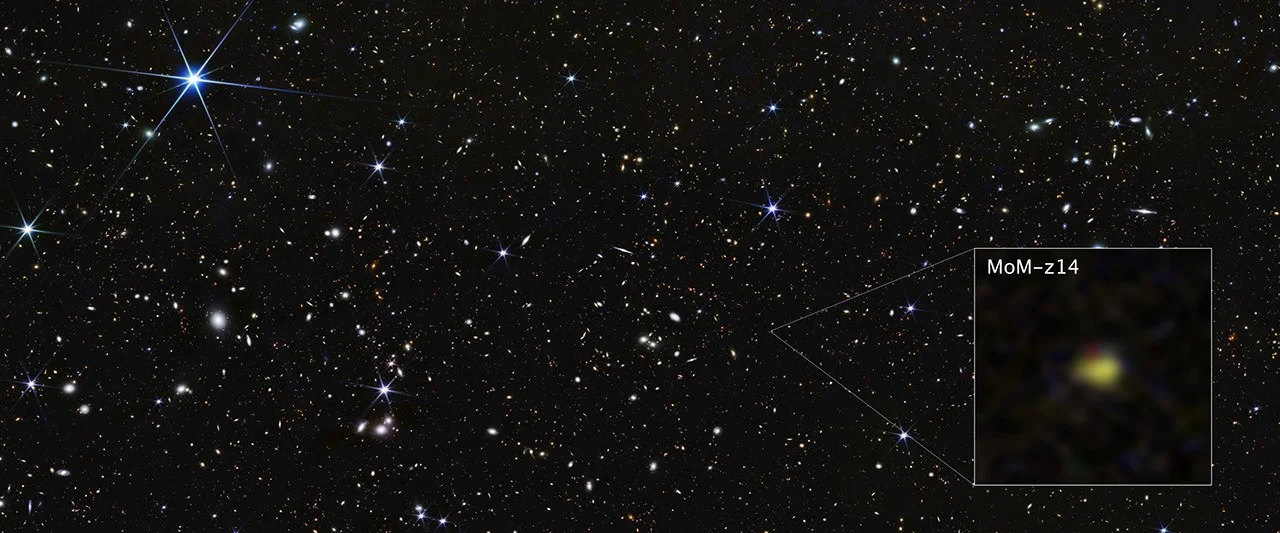
Webb Spots MoM-z14: A Bright Beacon 280 Million Years After the Big Bang

NASA’s James Webb Space Telescope confirmed the bright galaxy MoM-z14 at a cosmological redshift of 14.44, placing it about 13.5 billion years in the past and roughly 280 million years after the Big Bang. It is about 100 times brighter than prelaunch predictions, challenging existing models of the early universe and offering clues about unusual nitrogen enrichment and the epoch of reionization. Webb’s findings continue to push observational boundaries ahead of future missions like the Roman Space Telescope.

astronomy2 years ago

JWST Uncovers Secrets of the Early Universe and Dark Matter.

The James Webb Space Telescope (JWST) has observed galaxies with redshift values higher than seven (z>7) for the first time, using data from the Mid-Infrared Instrument (MIRI). The H-alpha emission line, visible in the mid-infrared spectrum for galaxies with high redshifts, was resolved by the international team of researchers, allowing them to study star formation in these early galaxies. The team hopes to follow up by observing these same galaxies using Webb’s suite of spectrometers to learn more about the shape of the galaxies’ emission lines and the dynamics of star formation.