President Trump will permit a bipartisan housing bill to become law without his signature, using the move to protest the GOP-backed voter ID law and signaling tensions within the party while pushing the housing legislation forward.
President Trump says he will not sign the bipartisan 21st Century ROAD to Housing Act in protest of Republicans' failure to pass the SAVE America Act, but the housing affordability bill is set to become law automatically on Saturday unless he vetoes it. He has urged Republicans to push to end the Senate filibuster to pass the election measure, while Senate Republicans say they lack the votes. The White House cited his Truth Social post in the decision, illustrating a developing dispute ahead of the midterms.
Mortgage rates sit around 6.49% for a 30-year fixed, while existing-home sales fell 2.4% in June. A bipartisan bill—the 21st Century Road to Housing Act—aims to boost supply by easing manufactured housing and funding repairs, and is set to become law automatically unless vetoed. Analysts say any meaningful relief in prices or availability will take time, though forecasts suggest rates could drift toward about 6.3% by late 2026, with prices remaining high in the near term.
During a CNBC interview from the Oval Office, Trump says he feels bad his family faces conflicts of interest over investments, reveals his son Eric handles his finances via semi‑blind trusts, vows to oust Fed Governor Lisa Cook, offers a tepid stance on a bipartisan housing bill while pushing to attach the SAVE Act, and accuses liberal Supreme Court justices of voting as a bloc.
President Donald Trump called a bipartisan housing bill a 'big yawn' and has not signaled which way he’ll lean on it; the measure Johnson sent to the White House would bar institutional investors from buying single-family homes and could become law after 10 days if he stays silent, or be vetoed. The development comes as Republicans fret over messaging ahead of a tight midterm contest after Trump canceled a Capitol signing ceremony to push the unrelated SAVE America Act.
A bipartisan housing affordability bill is headed to President Trump’s desk after House Speaker Mike Johnson said transmission will occur Monday; Trump had paused signing earlier, but the measure—aimed at increasing housing supply, streamlining environmental reviews, easing manufactured-home construction, and limiting institutional investors—could become law in 10 days if he takes no action, or be vetoed with a potential congressional override. The bill passed 358-32 in the House and 85-5 in the Senate.
President Trump publicly pressed House Republicans to stop stalling procedural votes, helping Speaker Mike Johnson push the SAVE America Act forward, as Johnson transmitted a bipartisan housing bill to the White House—signaling progress after Trump had previously refused to sign it—and drawing mixed reactions from GOP lawmakers about using procedural tactics that have slowed the House’s work.
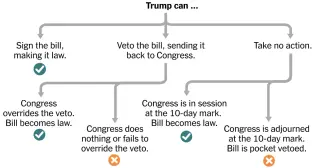
The bipartisan housing bill cleared Congress but is now in limbo after President Trump canceled plans to sign it. The bill could become law if Congress forwards it and Trump does not act within 10 days; it could be pocket-vetoed if Congress adjourns or is in recess when the period ends; or Trump could veto it, forcing a two-thirds override in both chambers for it to become law. Speaker Johnson may move the measure forward or adjust recess timing to avoid a pocket veto, but legal questions about recess vs. adjournment cloud the timing. The outcome hinges on Trump’s next move and how Congress handles the clock, with Republicans eager to show progress on high living costs.
President Donald Trump is staging a sprawling 16-day “Great American State Fair” in Washington, D.C. to fête America’s 250th birthday—part campaign rally, part state fair—while also canceling the signing ceremony for a bipartisan housing bill, signaling a high‑profile, theater-like political move in the capital amid ongoing renovations.
At a closed-door Capitol lunch, Sen. Bill Cassidy pressed President Trump over U.S. Iran war powers, insisting on more information before backing a war powers resolution; Trump challenged him and the two traded barbed remarks before Cassidy sat down to de-escalate. The episode comes as Cassidy, who recently lost a Louisiana Senate primary to a Trump-backed opponent, emphasizes accountability, while Trump also canceled a signing ceremony for a bipartisan housing bill and pressed other policy priorities.
President Trump canceled signing of a bipartisan housing bill to press Congress on the SAVE America Act, triggering a tense closed-door lunch with Senate Republicans that featured a heated exchange with Sen. Bill Cassidy and underscored deep GOP divisions ahead of the midterms.
President Trump canceled a planned signing of a bipartisan housing bill, saying he will not sign until Congress passes the SAVE America Act, signaling leverage over election reform amid Republican dissent and Democratic skepticism about its chances.
The House approved the Road to Housing Act in a 358-32 vote to relax local regulations and spur more affordable housing construction, including incentives for manufactured housing and limits on future purchases by institutional investors; it also contains a crypto provision barring a federal digital dollar and now heads to President Trump for signature. The measure does not address mortgage rates or sharp price declines, which lawmakers say limits its short-term impact.
Rep. Anna Paulina Luna warned she and a small bloc of Republicans would block procedural steps to push back against the House GOP leadership’s plan to advance a bipartisan housing bill, urging that the SAVE America Act be prioritized instead. Speaker Mike Johnson still plans a Tuesday evening vote to move the housing bill toward a White House signing, but Luna’s threat—and her call for Trump to veto the bill to force inclusion of the elections measure—could derail related appropriations and stall floor action if followed.
Elizabeth Warren and Maxine Waters, longtime Democratic allies on economics, are clashing over how to frame the biggest housing reform in decades: Warren backs a Senate bill restricting Wall Street’s housing investments, while Waters cut a more industry-friendly deal in the House. The House bill passed; the Senate’s path is uncertain as leadership on both sides push different versions, with White House backing the House after last-minute changes. The dispute centers on private equity rules and built-to-rent provisions, illustrating a broader Capitol Hill rift as lawmakers seek to boost housing affordability.