Tag

Interoception

All articles tagged with #interoception

Focused attention on bodily sensations dampens acute inflammation via brain–body pathways
science8 days ago

Focused attention on bodily sensations dampens acute inflammation via brain–body pathways

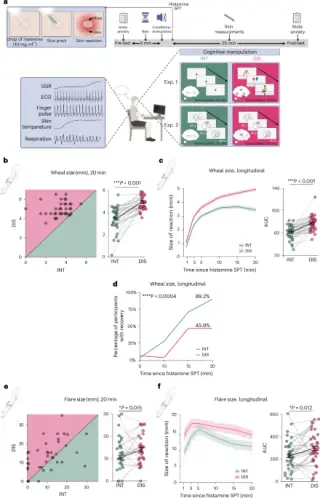
A three-study, pre-registered investigation using histamine skin-prick inflammation shows that directing attention inward to bodily sensations produces smaller, faster-resolving wheal and flare responses than focusing on external distractors. The effect is robust across participants (about 90% showing the pattern) and is linked to increased parasympathetic (vagal) activity, suggesting two mechanisms: sensory modulation of inflammation-related signals and a top-down autonomic pathway. Notably, reducing sensory input with lidocaine did not abolish the effect, indicating that purely top-down attention can sustain anti-inflammatory regulation. The findings integrate attention, perception, and immune control, with implications for mindfulness-based therapies, while acknowledging model limits and the need to test generalizability to other immune challenges.


Interoception: The Body's Hidden Sense That Shapes Mood and Health
science1 month ago

Interoception: The Body's Hidden Sense That Shapes Mood and Health

Researchers are exploring interoception, the body's ability to sense internal signals, as a potential sixth sense that helps regulate mood and mental health conditions such as anxiety, depression, PTSD, and eating disorders, with findings noting sex differences and links to mood stability and treatment potential, though the field remains debated.

Tiny Breaks, Big Boost: Five-Minute Moves to Revive Your Workday
health3 months ago

Tiny Breaks, Big Boost: Five-Minute Moves to Revive Your Workday

Sitting all day harms the body by limiting muscle stimulation, constricting the diaphragm, and dulling interoceptive signals. The interview with Manoush Zomorodi promotes five-minute movement breaks every 30 minutes (or hourly) for two weeks, showing up to a 28% drop in fatigue, improved attention and mood, and a 4% gain in productivity. Breaks can be anything from walking to simple arm movements or even imagining a dog walk; if walking isn’t possible, you can still move. Over time, people’s internal urge to move returns, reducing reliance on timers. The advice complements regular exercise and helps restore the body’s signals for movement in a tech-saturated world.

Gut–brain interoception drives age-related cognitive decline
science5 months ago

Gut–brain interoception drives age-related cognitive decline

Researchers show that aging gut microbiota produce higher levels of medium-chain fatty acids, triggering peripheral inflammation via GPR84 and weakening vagal gut–brain signaling. This interoceptive dysfunction impairs hippocampal memory in aged mice, with promising interventions—phage targeting of Parabacteroides, GPR84 inhibitors, or boosting vagal activity—able to restore memory.

How Detecting Hunger Shapes Our Mood: The Science Behind Hangry
science7 months ago

How Detecting Hunger Shapes Our Mood: The Science Behind Hangry

A month-long study with 90 healthy adults using continuous glucose monitors and smartphone mood checks found that mood worsens primarily when people perceive hunger, not simply when blood sugar drops. Those with higher interoceptive accuracy—better awareness of internal bodily states—showed fewer mood swings. Hunger signals involve the hypothalamus and insula, and improving interoception through attention to body cues and exercise may help stabilize moods and prevent impulsive eating. The piece, republished from The Conversation, also notes the everyday relevance for parents managing kids' meals.

Humans May Have 22–33 Senses, Not Just Five
scienceneuroscience7 months ago

Humans May Have 22–33 Senses, Not Just Five

New research and expert discourse suggest that human perception rests on 22–33 senses, far beyond the classic five. Proprioception, interoception, vestibular balance, sense of agency, and sense of ownership are part of a distributed, multisensory system that blends touch, taste, smell, and sight to create flavor, texture, and self-awareness. Everyday experiences—such as odors altering taste or sounds changing perceived texture—reflect this interconnectedness. Work at the Centre for the Study of the Senses and Crossmodal Laboratory in Oxford, alongside exhibitions like Senses Unwrapped, illustrate how our senses continually negotiate a single, coherent reality.

Scientists Launch $14.2M Project to Map Human 'Sixth Sense'
science10 months ago

Scientists Launch $14.2M Project to Map Human 'Sixth Sense'

Scientists at the Scripps Research Institute and the Allen Institute, backed by the NIH, are mapping the brain's internal communication network called interoception, which monitors vital bodily functions. This project aims to create the first neural atlas of this 'sixth sense,' potentially transforming our understanding of health and disease by revealing how the brain and internal organs stay in sync, and offering new avenues for treatment of various conditions.

Scientists Launch $14.2 Million Project to Map the Human Sixth Sense
science10 months ago

Scientists Launch $14.2 Million Project to Map the Human Sixth Sense

Scientists from Scripps Research and the Allen Institute, led by Nobel laureate Ardem Patapoutian, received $14.2 million from the NIH to create the first comprehensive map of interoception, the body's internal sensory system, aiming to better understand how the brain monitors internal signals and its implications for health and disease.

Scientists Reveal How Alcohol Alters Bodily Sensations
health1 year ago

Scientists Reveal How Alcohol Alters Bodily Sensations

A study in the Journal of Psychopharmacology reveals how alcohol alters internal bodily sensations, with less sensation linked to higher risk of alcohol use disorder. Using digital mapping and physiological measures, researchers found that alcohol-induced bodily sensations vary during intoxication and are connected to subjective feelings of stimulation and sedation, potentially influencing addiction vulnerability. The study also highlights placebo effects and individual differences in bodily awareness, offering new insights into the role of interoception in alcohol experiences and addiction risk.

Interoception Linked to Increased Female Sexual Satisfaction
health1 year ago

Interoception Linked to Increased Female Sexual Satisfaction

A study by the University of Essex reveals that women with higher interoception, or awareness of internal bodily signals, experience more frequent and satisfying orgasms. This inward focus enhances sexual satisfaction in both solo and partnered encounters, emphasizing the importance of understanding normal orgasmic processes for improving well-being and relationship satisfaction. The research highlights the role of bodily awareness in fostering sexual satisfaction, offering insights for women and their partners.