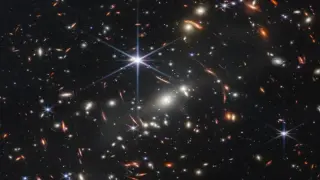
Hidden Low-Mass Stars Make Early Massive Galaxies Much Heavier Than Thought
Webb Space Telescope observations (with VLT data) published in Nature Astronomy reveal a hidden population of small, faint stars in nine of the universe’s most massive early galaxies, implying those systems are far more massive than previously estimated. By analyzing subtle spectral signatures of low-mass stars, researchers found many more dwarfs than bright stars alone would suggest, with one galaxy formed within roughly 1.5 billion years after the Big Bang potentially four times heavier than thought. This challenges existing models of early galaxy growth and could have implications for planet formation around low-mass stars in the ancient universe.