
Tag

Manikomycin

All articles tagged with #manikomycin

Soil-born antibiotic hits a novel ribosome site to tackle resistant bacteria
science2 months ago

Soil-born antibiotic hits a novel ribosome site to tackle resistant bacteria

Researchers from the U.S., Canada, and Germany identify manikomycin, a naturally produced peptide antibiotic from the soil bacterium Streptomyces rimosus, that binds a previously untargeted site on bacterial ribosomes and kills difficult strains like Escherichia coli and Klebsiella pneumoniae; while promising due to its novel mode of action, it does not affect many Gram-positive bacteria and metabolizes quickly in the body, meaning it’s not yet a drug and will require optimization before clinical use.

Manikomycin reveals a new weakness in drug-resistant bacteria by blocking ribosome exit
science2 months ago

Manikomycin reveals a new weakness in drug-resistant bacteria by blocking ribosome exit

McMaster University researchers led by Gerry Wright discovered manikomycin, a novel antibiotic that blocks the ribosome exit site, effectively killing drug-resistant bacteria such as Salmonella, E. coli and Klebsiella and representing a new class of antibiotics; found by fractionating extracts of Streptomyces rimosus, it is non-toxic to human cells in early tests, with 60 derivatives developed and plans to optimize its activity and expand its spectrum.

MKM: a natural antibiotic locking the bacterial ribosome at the E-site
science2 months ago

MKM: a natural antibiotic locking the bacterial ribosome at the E-site

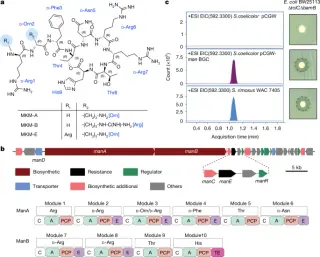
Manikomycin (MKM), a newly identified cyclic depsipeptide from Streptomyces rimosus, binds the E-site of the bacterial 50S ribosome to block translocation and halt protein synthesis. It kills multidrug‑resistant Enterobacteriaceae and mycobacteria, with resistance arising from mutations in 23S rRNA near the E-site or loss of ribosomal protein L35; the producer carries ManE, a methyltransferase that methylates Cm2395 to confer self-resistance. Cryo-EM reveals MKM in the primary E-site pocket formed by 23S rRNA and L35; biochemical and ribosome profiling data show context‑dependent translation inhibition. Activity is limited in many bacteria due to uptake, but MKM offers a new scaffold for antibiotic development, supported by in vitro, ex vivo, and pharmacokinetic data.