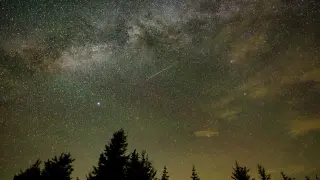
APOD's August 19, 2026 entry analyzes a fleeting bright object seen near the Perseids from Spain; after checking time, location, and radiant, experts conclude the incident was an airplane contrail reflecting sunlight rather than a meteor.
NASA’s APOD explains that a bright streak seen during the 2026 Perseids was misinterpreted as a meteor, but analysis shows it was a sunlit airplane contrail, highlighting how reflections and timing can mimic meteoritic events.
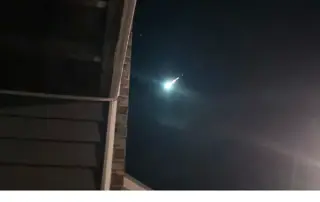
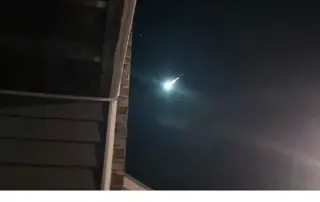
A bright fireball was seen streaking across the Washington sky early Friday, accompanied by flashes of light. Dozens of observers shared video clips, with many suggesting it could be a meteor. No injuries were reported as footage circulated of the event from Chimacum-area viewers.
BAE Systems is testing how the Eurofighter Typhoon can control uncrewed collaborative combat aircraft (CCA) as part of the Long-Term Evolution program, using the LAD cockpit, ECRS Mk 2 radar and Striker II helmet to boost combat mass, persistence and range; CCAs could field Meteor missiles and operate alongside Typhoons, F-35s and the Tempest, with data links to share targeting and updates to reduce pilot workload, in line with the RAF’s Storm Fighter initiative and synthetic drone trials that demonstrate crewed-uncrewed teaming for UK air combat.
A new study identifies Chicxulub’s impactor as a rare carbon monoxide–bearing chondrite, a meteorite type comprising about 5% of samples. While this confirms the asteroid theory for the dinosaurs’ extinction, researchers say atmospheric debris—not sulfur in the meteorite—was the main killer, and trace elements in a KT boundary clay point to an origin from the outer asteroid belt near Jupiter or the distant solar system.
Dozens of dawn sightings across the Carolinas and several other states suggested a meteor, but the American Meteorological Society confirmed the object was a rocket launch, tracing its diagonal path across the sky and ending the mystery.
A bright green fireball lit up the night across at least 15 states from near Memphis toward St. Louis, with roughly 400 reports to the American Meteor Society. Experts say it was a meteor, not a satellite, and the green color comes from vaporized nickel or magnesium as it sped through the atmosphere at about 25,000 mph, often breaking apart before disappearing.
A bright green fireball lit up the night sky Sunday across at least 15 states from near Memphis toward St. Louis, with observers noting up to 20 seconds of visibility and sparks along its path. About 400 reports were logged with the American Meteor Society, and scientists say the event was a natural meteor, not a satellite, with the green color caused by vaporized metals (nickel or magnesium) at speeds exceeding 25,000 mph.
A meteor blaze lit up the night above Arizona’s Kitt Peak National Observatory, captured by Petr Horálek, NOIRLab Audiovisual Ambassador. The image frames the WIYN telescope domes and nearby constellations (Orion and Canis Major), illustrating how rare and difficult it is to photograph a meteor in motion and highlighting the observatory’s place on Tohono O’odham Nation land as part of NOIRLab.
A three-foot meteoroid streaked over New England on May 30, 2026, punching through the atmosphere at about 75,000 mph and breaking apart around 40 miles up with an energy near 300 tons of TNT, unleashing a double sonic boom heard from Delaware to Montreal; NASA confirmed it was a natural object, not space debris or a satellite, and no injuries or ground impact were reported, with any fragments likely sinking into the ocean. USGS registered no seismic event, highlighting how atmospheric fireballs can be detected and documented without earthquakes. This event fits into a year with several large fireballs and underscores the growing role of coordinated observation networks in recording such phenomena.
NASA says the Cape Cod Bay meteor was likely an iron meteorite, unusually dense at about 8,000 kg/m³, broke apart around 31 miles up with few small fragments, and could potentially be recovered from the ocean floor; the density estimate is preliminary and awaits further analysis.
A daytime meteor exploded over the Northeast on May 30, releasing energy about 300 tons of TNT. NASA confirmed the event using eyewitness reports and GOES-19 satellite imagery, noting the bolide likely fragmented at ~40 miles altitude; meteorites reportedly fell into Cape Cod Bay, with no land recoveries.
NASA confirmed a bright daytime fireball meteor, about 5 feet (1.6 meters) in diameter, exploded over the northeastern United States on May 30, releasing energy roughly equal to 230 tons of TNT. The object streaked through the atmosphere at about 42,000 mph (67,000 km/h), broke the sound barrier about 31 miles up, and debris rain fell over Cape Cod. An NOAA satellite captured the event, and there were no injuries or property damage reported, though residents heard a loud sonic boom. NASA notes such small meteors are common and pose little risk to cities.
NASA confirmed a meteor broke apart about 40 miles above northeastern Massachusetts on May 30, releasing energy equivalent to roughly 300 tons of TNT and producing a loud boom heard as far as Rhode Island and Cape Cod. Pieces reportedly landed in Cape Cod Bay. The American Meteor Society logged over 80 witness reports across several states and Canada, with dash-cam and home-surveillance videos capturing the fireball and the blast.
A confirmed bolide meteor about three feet wide streaked across New England on Saturday, traveling roughly 75,000 mph and creating a loud sonic boom before likely splashing into Cape Cod Bay. NASA and the American Meteor Society used satellite and radar data to triangulate its trajectory and origin.