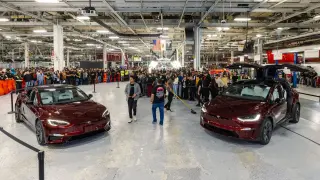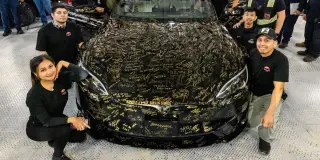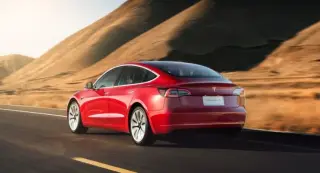
Tesla produced its last Model S and Model X at its Fremont factory, ending 14-year and 11-year runs for the big cars as the plant will be repurposed to mass-produce Optimus humanoid robots; with only Model 3, Model Y, and Cybertruck remaining in the lineup, the company marked the moment with Signature Edition final cars priced at $159,420.
Tesla has officially ended Model S and Model X production at Fremont to shift capacity toward its Optimus humanoid-robot project, citing years of declining sales; Model 3 and Cybertruck will continue, with a future second-gen Roadster teased. The company issued limited 'Signature Edition' send-offs for the S Plaid (250 units) and X (100 units) at $159,420, though a May 12 delivery event was postponed.
Tesla posted a Q1 profit of $477 million on $22.39 billion in revenue (below expectations) as car sales rebounded; CEO Elon Musk outlined a hefty investment push into self‑driving taxis, humanoid robots (Optimus) and AI infrastructure, with capital expenditure forecast above $25 billion this year, signaling a shift toward services and automation even as traditional EV sales slow and competition heats up.
Tesla posted Q1 revenue of $22.4B (up 16%) and net income of $477M (up 17%), but operating expenses rose 37% to $3.78B, squeezing margins to 4.2% as the company accelerates AI investments in humanoid robots, self-driving tech, and AI chips. Musk signaled a significant capex rise for future revenue, with Model S/X discontinued to make way for Optimus; the Cybercab may eventually replace the Model Y. Q1 deliveries were 358,023 (below expectations of ~370k). Tesla also targets 2026 volume production for Cybercab and Semi and is partnering with SpaceX on a large chip fab, signaling higher capital expenditure for future growth.
Tesla’s Q1 2026 earnings call on April 22 will focus on autonomous tech and growth: unsupervised Robotaxi expansion in Dallas/Houston and broader rollout ambitions, upcoming mass production of the Cybercab, and the European FSD rollout with a timeline for unsupervised driving; investors will watch for updates on FSD versions 14.3 and 15, Optimus, and a hinted new vehicle. The piece also covers the Spring 2026 software update for Intel-based Teslas, detailing features like the Self-Driving app, Hey Grok wake word (limited to HW4), Pet Mode, enhanced visuals, Dashcam upgrades, and rear-screen maps, with many features limited to AMD/HW4 models. Additionally, Tesla has begun hiring FSD Vehicle Operators in nine countries to support a global rollout, signaling an expanded international strategy.
Tesla is on track for an eighth consecutive weekly loss, about 23% down year-to-date, as investors await catalysts such as version 3 of the Optimus robot, robotaxi updates, and a cheaper EV SUV. Q1 deliveries rose 6.3% year over year to 358,023, with an April 22 earnings report expected to shed more light on catalysts; analysts show a Hold rating with an average target of about $392.63, implying roughly 14% upside.
Elon Musk announced Terafab, a massive semiconductor plant to be built in Austin by xAI, SpaceX and Tesla, targeting up to 1 terawatt of output per year. The factory would create an end‑to‑end loop for chip design, masks and testing and produce two main chip types: high‑power chips for Optimus robots and EVs, and space‑grade chips designed to endure harsh space environments. Musk says Terafab aims to accelerate robotics, AI and space initiatives and envisions a future with abundant access to advanced technology and interplanetary travel.
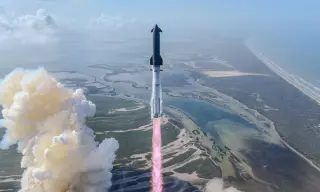
Elon Musk reportedly shifts SpaceX’s focus from Mars to a self-sustaining Moon city, using lunar soil and 3D printing to expand a lunar base and Optimus robots to build infrastructure before humans arrive, with aims for unmanned Starship landings by 2027 and lunar factories/data centers for AI.
Tesla’s stock has climbed about 134% over three years and could double if Optimus reaches human-level proficiency by 2026, supported by a planned 2026 production start, heavy emphasis on real-world AI training data, and a shift to recurring AI services. While optimism for long-term profitability is high, near-term results depend on capital spending and successful scaling of production, so a rapid double this year is unlikely unless earnings growth accelerates.
Tesla plans roughly $20 billion in capital expenditure this year to transform its business, including converting a former Model S/X factory to build Optimus humanoid robots and reviving rooftop solar via a Buffalo, NY facility. The move spurred a rally in TSLA shares (about 5%), while Canaccord Genuity issued a Buy rating; Wall Street’s consensus remains a Hold with a price target around $401.27, implying about 8% downside risk.
Tesla signals a shift from selling cars to focusing on autonomous technology and humanoid robots, retiring its Model S/X lineup to prioritize a “transportation as a service” future. It touts rising Full Self-Driving subscriptions, plans for robotaxis, and ongoing heavy spending on Optimus, Cybercab, and battery projects, while vehicle sales remain pressured and the business leans more toward software and services.
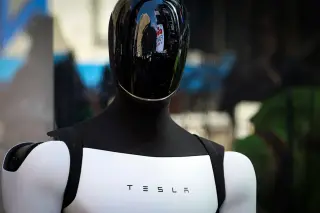
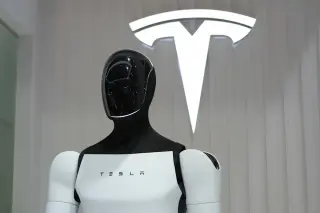
Elon Musk announced that Tesla will wind down production of the Model S and Model X in Q2 2026 and retool the Fremont factory to mass-produce the Optimus humanoid robot, signaling a shift from luxury EVs to automation and AI-driven robotics; the company aims for up to one million Optimus units per year, backed by more than $20B in 2026 capex, a TerraFab chip facility, and a $2B investment in xAI, as automotive revenue declines and BYD overtakes Tesla in EV sales.
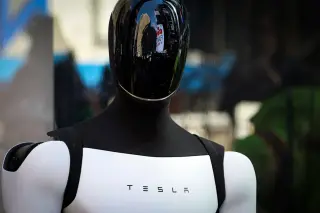
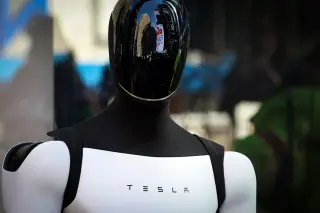
Tesla signaled a dramatic pivot on its earnings call, planning to convert its Fremont Model S/X production space into an Optimus robot factory and pursue as many as 1 million humanoid robots per year. Musk frames Optimus as the key to universal abundance, but critics warn the goal risks eclipsing its core EV business as competition intensifies and tax credits fade; experts say humanoid robots face substantial technical and market hurdles and are unlikely to replace cars soon.
Tesla will halt production of the Model S and Model X next quarter and convert Fremont’s production space into Optimus humanoid-robot manufacturing, aiming to produce up to 1 million Optimus units in the existing S/X space and to start selling Optimus to the public by the end of next year, while continuing to support remaining Model S/X inventory.
Tesla will discontinue the Model S and Model X, converting its Fremont factory to produce the Optimus robot as part of Elon Musk’s pivot from hardware to AI and robotics amid slipping vehicle sales; Optimus production is planned for 2026 with a public sale in 2027, while Tesla expands AI initiatives including xAI to fuel future growth.