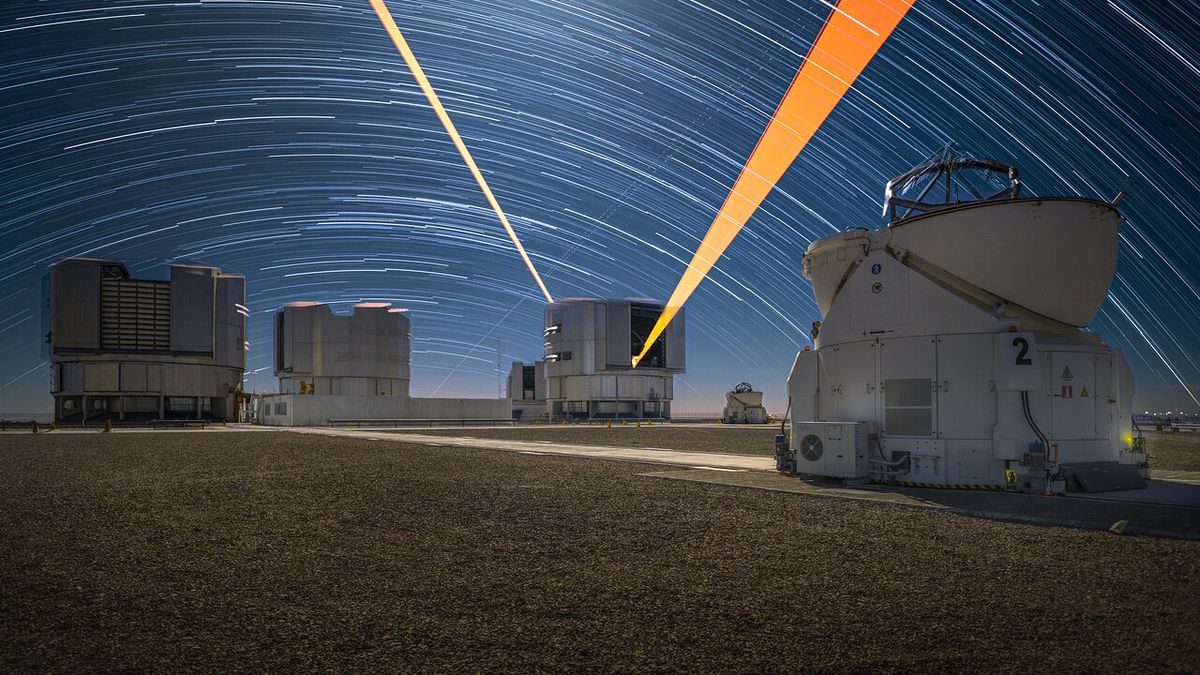
APOD's Aug 28, 2026 image from ESO's Paranal Observatory in Chile stacks 300 frames of 25 seconds each to trace star trails around the south celestial pole, illustrating Earth's rotation at about 1,500 km/h as seen from 25°S, with the AT 3 telescope visible in the foreground.
In Chile’s Atacama Desert, home to ESO’s Paranal Observatory, some of Earth’s darkest skies are increasingly affected by artificial light from nearby cities, mining and growing satellite traffic. A proposed nearby megaproject, Inna, could have raised light levels at the observatory by as much as 50% and introduced air turbulence, prompting scientists to push for tighter regulations beyond a 10% threshold. Although AES Andes canceled Inna in 2026, enforcement of light-pollution rules remains weak, and the International Astronomical Union’s 2025 guidelines call for lower limits and a possible secondary norm to empower government action to dim lights if needed. The issue underscores a global struggle: preserving dark skies is crucial for astronomy and our understanding of the universe, even as technology and industry encroach.
The Atacama Desert in Chile hosts some of the world’s most powerful astronomical facilities thanks to exceptionally dark skies, but growing urban expansion, mining, wind farms, and a canceled nearby green-energy project have spotlighted how light pollution and regulations threaten these observatories and their ability to study the universe—spurring calls for stricter sky-preservation rules to safeguard projects like the ELT and the search for Earth‑like planets.
A $10 billion plan to build a light-polluting green hydrogen plant near ESO’s Cerro Paranal observatory in Chile has been cancelled by AES Andes, relieving astronomers who warned the project would degrade the world-renowned dark skies and threaten facilities like the VLT and ELT. ESO calculations suggested up to a 35% increase in light pollution, which could undermine cutting-edge observations, prompting widespread concern in the astronomy community. The cancellation allows Paranal and Atacama-region telescopes to continue operating under optimal sky conditions while AES Andes shifts focus to renewable energy projects.
The European Southern Observatory (ESO) has shared a stunning image of star trails captured at its Paranal Observatory in Chile. The image shows the movements of stars over several hours, creating a trailing effect. Two bright orange lasers, known as laser guide stars, are also visible, which are used to correct the distortion of starlight caused by Earth's atmosphere. The long exposure technique captures the Earth's rotation and showcases the beauty of the night sky.