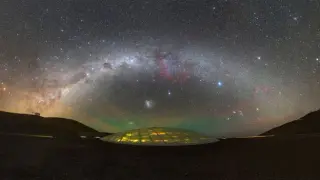
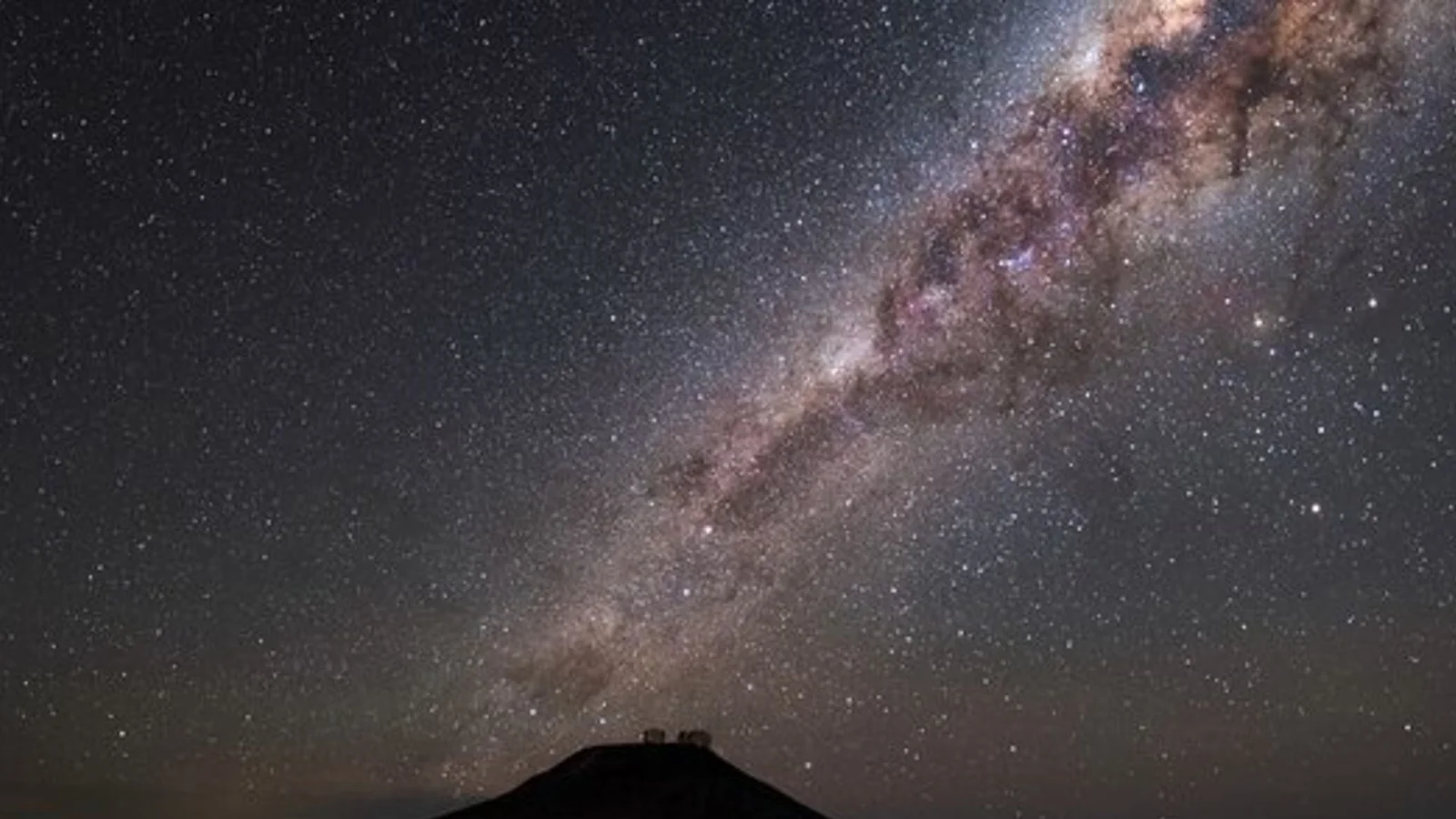
APOD's Aug 28, 2026 image from ESO's Paranal Observatory in Chile stacks 300 frames of 25 seconds each to trace star trails around the south celestial pole, illustrating Earth's rotation at about 1,500 km/h as seen from 25°S, with the AT 3 telescope visible in the foreground.
The European Southern Observatory’s Extremely Large Telescope (ELT) is being built atop Cerro Armazones in Chile’s Atacama Desert to become the world’s largest optical/infrared telescope, featuring a 39-meter segmented mirror inside an 80-meter dome. Slated to be completed by 2027 and operational by 2030, it will greatly improve resolution and light-collection, enabling detailed studies of distant galaxies, precise measurements of smaller exoplanets, atmospheric signatures that could hint at life, and potentially the first strong evidence of life beyond Earth, though experts caution about what would count as proof.
Astronomers using ESO's VLT CRIRES+ measured an exceptionally fast equatorial jet on the bloated hot Jupiter WASP-127b (about 520 light-years away). Doppler shifts in water vapor and carbon monoxide during transit reveal two opposing velocity peaks, indicating a strong eastward jet. After subtracting the planet’s rotation, the jet speed is 7.7 ± 0.2 km/s (roughly 27,700 km/h); including rotation, the maximum equatorial motion reaches about 9 km/s (≈33,000 km/h)—the fastest wind observed on any planet. The result demonstrates a method to map atmospheric circulation on unresolved exoplanets and confirms molecules in the atmosphere, while suggesting cooler poles or high-altitude clouds and paving the way for finer measurements with the Extremely Large Telescope.
The Atacama Desert in northern Chile—arguably Earth’s driest non-polar region—serves as a Mars-like laboratory with salt flats, near-lifeless soils, and some of the clearest, darkest skies, helping scientists study life beyond Earth and test how we search for it on other worlds, while looming light pollution threatens to erase this crucial astronomical window.
Astronomers have identified the first known exomoon—a Jupiter-mass satellite orbiting a brown dwarf (CD-35 2772) about 71 light-years away—discovered via radial velocity measurements, challenging how we classify planets and moons and signaling more exomoon hunts with the forthcoming ELT.
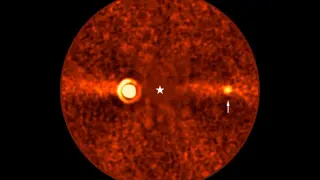
Using ESO's Very Large Telescope and archival JWST data, researchers confirmed Beta Pictoris d—an outer, 2.4-Jupiter-mass planet orbiting the nearby star Beta Pictoris. It is the faintest exoplanet ever directly imaged from Earth, lying more than twice as far from its star as its siblings and at about 64 light-years away. With a temperature around 330°C, it demonstrates how repeated observations and advanced instruments can reveal low-mass worlds hidden in bright starlight, and suggests there are likely more planets awaiting discovery in this young system with future telescopes like the ELT.
The European Southern Observatory’s Extremely Large Telescope rotated its 3,500-ton structure for the first time on its Chilean mountaintop, marking a major milestone in its assembly. Weighing about 7.7 million pounds now, the ELT will grow larger as mirrors and instruments are installed later, ultimately surpassing 10 million pounds and enabling unprecedented views of the night sky.
In Chile’s Atacama Desert, the Residencia is a desert-blending, climate-controlled lodging for astronomers near ESO’s Paranal Observatory and the VLT. It’s famously film-friendly (a Quantum of Solace finale was shot there) but functions as a serious research hub with strict light-pollution controls, high-altitude living (no alcohol), and a cycle of night/day shifts as engineers work on the ELT nearby.
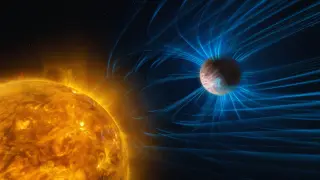
Scientists using ESO's Very Large Telescope and Gemini North measured wind speeds on seven hot, Jupiter-like exoplanets and found patterns best explained by global magnetic fields, marking the first robust evidence of magnetospheres around worlds beyond our solar system. The inferred magnetic strengths are roughly four times Saturn’s and about half Jupiter’s. This breakthrough opens a new window for exoplanet research, suggesting magnetically driven aurorae and paving the way for future ELT observations to characterize smaller, potentially habitable worlds.
In Chile’s Atacama Desert, home to ESO’s Paranal Observatory, some of Earth’s darkest skies are increasingly affected by artificial light from nearby cities, mining and growing satellite traffic. A proposed nearby megaproject, Inna, could have raised light levels at the observatory by as much as 50% and introduced air turbulence, prompting scientists to push for tighter regulations beyond a 10% threshold. Although AES Andes canceled Inna in 2026, enforcement of light-pollution rules remains weak, and the International Astronomical Union’s 2025 guidelines call for lower limits and a possible secondary norm to empower government action to dim lights if needed. The issue underscores a global struggle: preserving dark skies is crucial for astronomy and our understanding of the universe, even as technology and industry encroach.
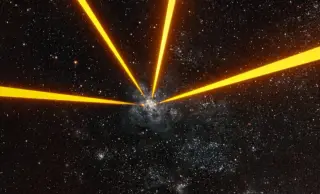
Astronomers use ESO's Very Large Telescope Interferometer to project four laser guide stars into the upper atmosphere, enabling adaptive optics that correct atmospheric distortion and produce crisper, space-like images from ground-based telescopes, including detailed studies of distant regions like the Tarantula Nebula.
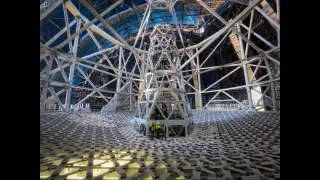
Space agency ESO released imagery of the ELT’s enormous 80-meter outer dome at Cerro Armazones in Chile. The dome will shelter a 39-meter primary mirror, protect optics from desert heat, and feature earthquake-resilient shock absorbers; the upper section will rotate to give the telescope full access to dark skies. The project is slated for completion in 2027, with first light planned for early 2029 and initial science observations in 2030.
Space.com explains that the Extremely Large Telescope (ELT) is under construction atop Cerro Armazones in Chile to become the world's largest telescope with a 39-meter primary mirror, enabling direct imaging of exoplanets and detailed studies of star and galaxy formation, while highlighting Chile's Atacama Desert as a premier site for ground-based astronomy and ESO's role alongside the VLT.
A $10 billion plan to build a light-polluting green hydrogen plant near ESO’s Cerro Paranal observatory in Chile has been cancelled by AES Andes, relieving astronomers who warned the project would degrade the world-renowned dark skies and threaten facilities like the VLT and ELT. ESO calculations suggested up to a 35% increase in light pollution, which could undermine cutting-edge observations, prompting widespread concern in the astronomy community. The cancellation allows Paranal and Atacama-region telescopes to continue operating under optimal sky conditions while AES Andes shifts focus to renewable energy projects.
Astronomers captured the earliest image of a supernova, SN 2024ggi, just 26 hours after explosion using ESO's VLT, revealing its olive-shaped geometry and providing new insights into the explosion mechanics of massive stars.