Tag

Rdp

All articles tagged with #rdp

FreeRDP Fixes High-Severity Memory Leak in RDPDR IRP Processing
technology1 day ago

FreeRDP Fixes High-Severity Memory Leak in RDPDR IRP Processing

A high-severity vulnerability, CVE-2026-137452, has been identified in FreeRDP versions prior to 3.33.0. The flaw involves a race condition in asynchronous RDPDR IRP processing that allows malicious RDP servers to leak client memory through non-atomic reference count updates. This can lead to denial of service by exhausting memory. The issue was fixed in FreeRDP 3.33.0, released on November 2, 2026, and further addressed in 3.33.1 on November 10, 2026.
FreeRDP 3.33.0 Patch Fixes Medium-Severity Out-of-Bounds Read in Smartcard Channel
technology1 day ago

FreeRDP 3.33.0 Patch Fixes Medium-Severity Out-of-Bounds Read in Smartcard Channel

FreeRDP versions prior to 3.33.0 contain a medium-severity out-of-bounds read vulnerability (CVE-2026-137454) in the client smartcard channel. The flaw allows a malicious RDP server to crash the client by sending a crafted request with an odd byte count, leaving a wide-string buffer without a proper terminator. The issue was fixed in FreeRDP 3.33.0, released in November 2026, and carries a CVSS 4.0 score of 6.9.

FreeRDP Patch 3.33.0 Fixes High-Severity Heap Corruption Flaw
technology1 day ago

FreeRDP Patch 3.33.0 Fixes High-Severity Heap Corruption Flaw

FreeRDP has released version 3.33.0 to address CVE-2026-137459, a high-severity vulnerability affecting versions 2.11.2 through 3.32.2. The flaw allows malicious RDP servers to trigger unbounded memory growth and client crashes by exploiting a stale frame ID in the progressive codec. The issue carries a CVSS 4.0 score of 8.7 and a CVSS 3.1 score of 7.5, posing a significant availability risk to remote desktop clients.

AI-Generated PowerShell Tool Maps Active Directory in Rapid Breach
security4 months ago

AI-Generated PowerShell Tool Maps Active Directory in Rapid Breach

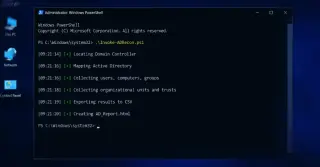
Cybersecurity researchers flag a June 2026 intrusion where attackers used an AI-generated, vibe-coded PowerShell script to enumerate a Windows Active Directory after gaining RDP access to a domain-joined server. The tool locates the Domain Controller, maps AD users, computers, groups, OUs, and trusts, creates a staging area, and exports results (including AD_Report.html). Attackers then deployed s5cmd and SharpShares to locate data repositories, exported data to CSV, archived it, and exfiltrated it to a remote server. The incident highlights how AI-assisted tooling lowers entry barriers and accelerates reconnaissance, aligning with established smash-and-grab playbooks, while a related Sygnia report notes AI-enabled cloud intrusions can scale quickly using credentials and cloud weaknesses rather than new malware.

Microsoft patches misrendered Remote Desktop warnings on multi-monitor PCs
technology7 months ago

Microsoft patches misrendered Remote Desktop warnings on multi-monitor PCs

Microsoft fixed a bug that caused the new Remote Desktop security warning dialog to render incorrectly on multi‑monitor setups after the April 2026 updates; the fix is in the optional Windows 11 KB5083631 preview (with 34 other changes). The issue affected Windows 11/10/Server and could make the warning dialog’s buttons unreadable or non‑interactive; it aligns with the standard RDP warning flow shown when opening preconfigured .rdp files. Separately, KB5083769 caused a VSS timeout that affected some backup apps on Windows 11 24H2/25H2, prompting out‑of‑band server fixes after the April updates.

RDP security prompts can misrender on multi-monitor setups after April updates
security7 months ago

RDP security prompts can misrender on multi-monitor setups after April updates

Microsoft warns of a bug where the new security warnings shown when opening Remote Desktop (RDP) files can render with unreadable text and misaligned buttons when multiple monitors use different display scaling, affecting Windows 11/10/Server after the April 2026 updates. The prompt appears before connecting and shows signer status and resource redirections; the issue follows increased attacker use of RDP in phishing campaigns (e.g., APT29).

Unveiling Hackers' Secrets: Researchers Expose Honeypot Tactics
cybersecurity3 years ago

Unveiling Hackers' Secrets: Researchers Expose Honeypot Tactics

Two security researchers deployed a network of honeypot computers exposed on the internet, allowing them to observe hackers remotely controlling compromised servers. The researchers recorded 100 hours of video footage and 190 million events, capturing hackers performing various actions such as reconnaissance, installing cryptocurrency mining malware, conducting click fraud, brute-forcing passwords, and even watching porn. The researchers classified the hackers into different types based on Dungeons and Dragons character types, including Rangers, Barbarians, Wizards, Thieves, and Bards. They believe that observing hackers in honeypots can provide valuable insights for researchers, law enforcement, and cybersecurity defensive teams.