Tag

S Nitrosylation

All articles tagged with #s nitrosylation

Nitrosylation Switch in STING Drives Alzheimer’s Brain Inflammation, Study Finds
health-and-medicine1 month ago

Nitrosylation Switch in STING Drives Alzheimer’s Brain Inflammation, Study Finds

Researchers at Scripps Research identified a chemical change known as S-nitrosylation of the STING protein at cysteine 148 that pushes brain immune cells into chronic inflammation in Alzheimer’s disease. Blocking this modification in a mouse model reduced neuroinflammation and protected synapses, and the same pathway was observed in human Alzheimer’s brain tissue and stem-cell models, suggesting a targeted therapy that quiets harmful inflammation without suppressing normal immunity. The team plans preclinical testing of small molecules to block cysteine 148.
Nitrosyl Switch in STING Fuels Alzheimer’s Brain Inflammation
science2 months ago

Nitrosyl Switch in STING Fuels Alzheimer’s Brain Inflammation

Researchers identify S-nitrosylation of the immune protein STING at cysteine 148 as a driver of brain inflammation in Alzheimer's; blocking this switch in mice reduced inflammation and protected synapses, with the same pathway active in human Alzheimer’s samples and stem-cell models, suggesting a new therapeutic target that dampens harmful inflammation without shutting down normal immunity.

Blocking a STING Switch Could Slow Alzheimer’s Brain Inflammation
science2 months ago

Blocking a STING Switch Could Slow Alzheimer’s Brain Inflammation

Researchers pinpoint S-nitrosylation of the STING protein at cysteine 148 as a driver of chronic brain inflammation and synapse loss in Alzheimer’s. In mouse models, preventing this modification reduced inflammation and protected synapses, a result mirrored in human Alzheimer’s tissue and stem-cell models. The findings suggest a targeted therapy that dampens harmful inflammation without suppressing overall immunity, with small molecules designed to block the cysteine-148 site in development.

Nitric Oxide Triggers TSC2 Loss, Overactivates mTOR in Autism
science4 months ago

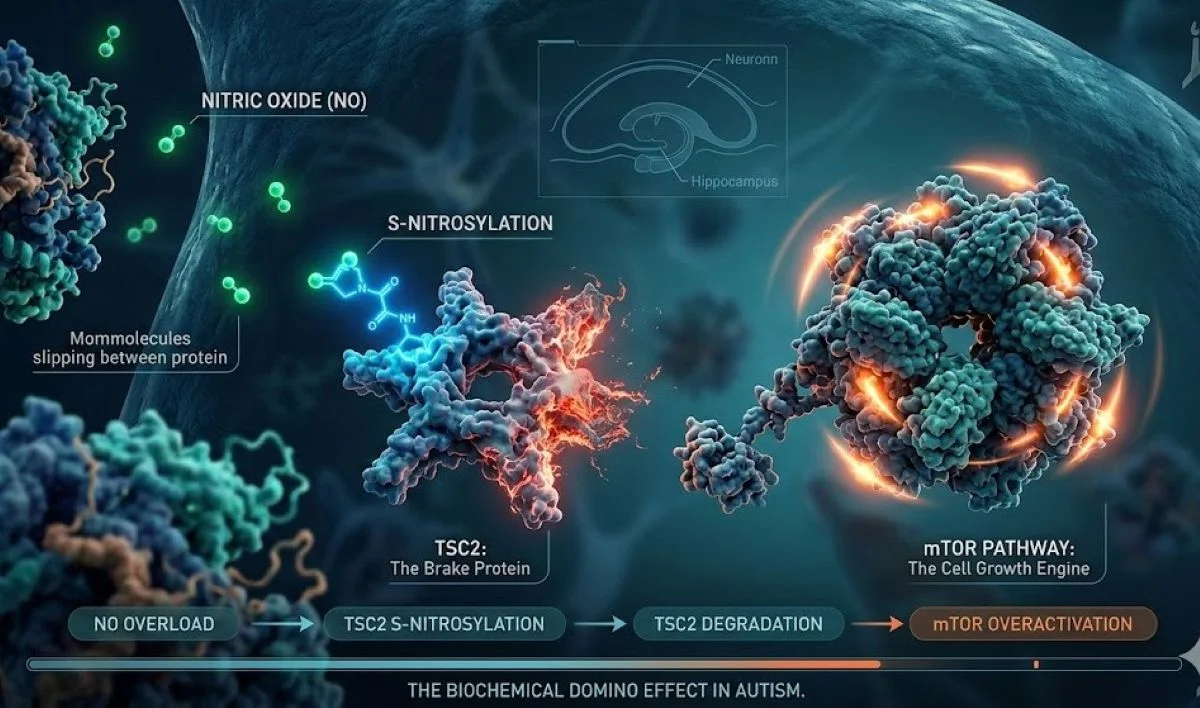
Nitric Oxide Triggers TSC2 Loss, Overactivates mTOR in Autism

Excess nitric oxide can modify TSC2 via S-nitrosylation, marking it for destruction and removing the mTOR 'brake.' With TSC2 diminished, mTOR activity surges, disrupting neuronal signaling in autism models. Blocking NO signaling or engineering a NO-resistant TSC2 normalized mTOR and improved related cellular readouts in SHANK3 and CNTNAP2 mouse models, and clinical samples from children with SHANK3 mutations and idiopathic ASD showed reduced TSC2 and elevated mTOR, supporting a NO–TSC2–mTOR mechanism and suggesting nitric oxide inhibitors as a potential ASD therapy and biomarker target.