Tag

Nitric Oxide

All articles tagged with #nitric oxide

Watermelon May Boost Heart Health and Diet Quality
health-and-medicine9 days ago

Watermelon May Boost Heart Health and Diet Quality

New research finds watermelon consumption is associated with higher-quality diets and better nutrient intake, including more fiber, minerals, vitamins, and antioxidants, while lower in added sugars and saturated fat. A small clinical trial suggests watermelon juice may help preserve vascular function during hyperglycemia by supporting nitric oxide pathways via L-citrulline and L-arginine. Watermelon's high water content makes it hydrating and low in calories, and its lycopene content may further support cardiovascular health, but larger long-term studies are needed.

Mouthwash, Nitric Oxide, and Blood Pressure: A Nuanced Look at the Science
science1 month ago

Mouthwash, Nitric Oxide, and Blood Pressure: A Nuanced Look at the Science

Social media claims that mouthwash drastically raises blood pressure are not supported. Research shows that strong mouthwashes (eg, chlorhexidine) can disrupt oral bacteria and impede nitrate-to-nitrite conversion, potentially raising systolic blood pressure in some short-term trials. However, milder, everyday mouthwashes generally have little effect on this pathway or on heart health, and a long-term study found no link between regular mouthwash use and cardiovascular death. The takeaway is to choose a milder mouthwash, use it as directed, and maintain good oral hygiene, since untreated oral disease is linked to cardiovascular risk.

Blocking nitric oxide normalizes autism-like traits in mice
neuroscience2 months ago

Blocking nitric oxide normalizes autism-like traits in mice

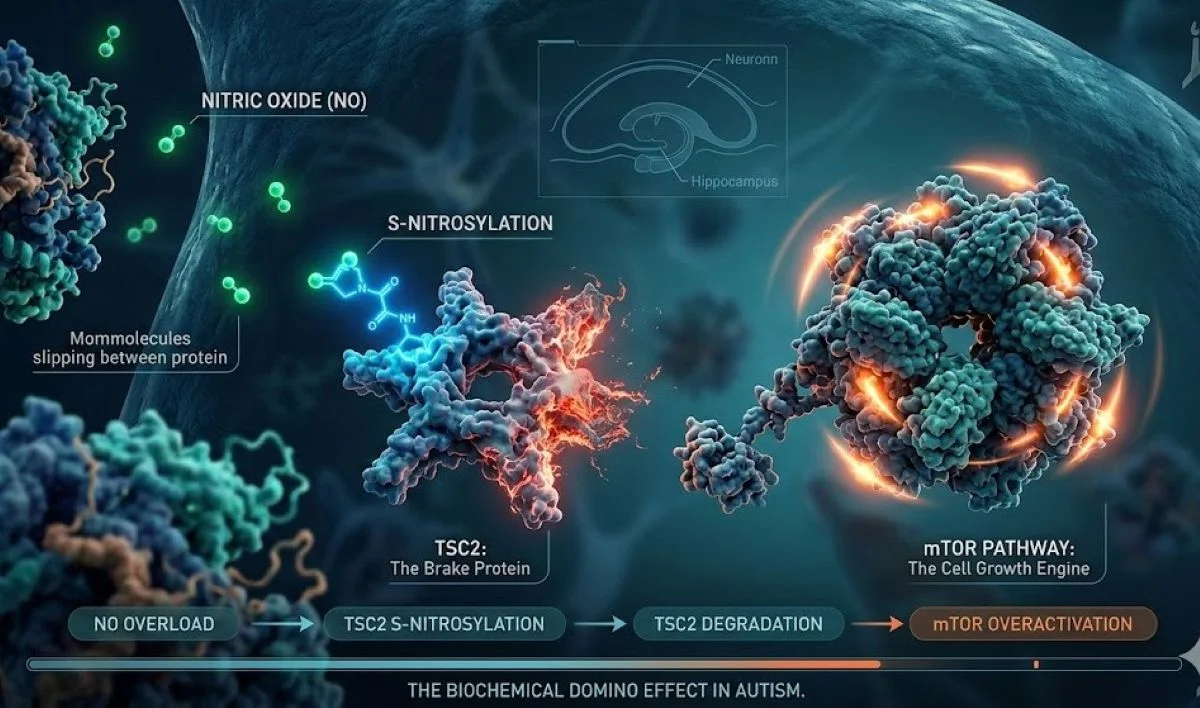
Researchers show that high levels of brain nitric oxide cause S-nitrosylation and destruction of the TSC2 brake protein, hyperactivating the mTOR growth pathway and leading to autism-like behaviors in Shank3/Cntnap2 autism-model mice. Blocking nitric oxide preserves TSC2, slows the mTOR pathway, and restores typical brain function and social behaviors in these mice; conversely, activating mTOR in healthy mice induces autism-like traits. The mechanism appears in human SHANK3-mutant neurons and in blood samples from autistic children, suggesting a conserved NO–TSC2–mTOR axis and a potential drug target, though limitations include small human sample sizes and the need for broader studies.

Nitric Oxide Triggers TSC2 Loss, Overactivates mTOR in Autism
science2 months ago

Nitric Oxide Triggers TSC2 Loss, Overactivates mTOR in Autism

Excess nitric oxide can modify TSC2 via S-nitrosylation, marking it for destruction and removing the mTOR 'brake.' With TSC2 diminished, mTOR activity surges, disrupting neuronal signaling in autism models. Blocking NO signaling or engineering a NO-resistant TSC2 normalized mTOR and improved related cellular readouts in SHANK3 and CNTNAP2 mouse models, and clinical samples from children with SHANK3 mutations and idiopathic ASD showed reduced TSC2 and elevated mTOR, supporting a NO–TSC2–mTOR mechanism and suggesting nitric oxide inhibitors as a potential ASD therapy and biomarker target.

Blocking SCoR2 Could Halt Fat Production and Lower Cholesterol
science-health3 months ago

Blocking SCoR2 Could Halt Fat Production and Lower Cholesterol

A Cleveland team identified SCoR2, an enzyme that removes nitric oxide from proteins controlling fat storage and production. In mice, inhibiting SCoR2 prevented weight gain, reduced liver damage, and lowered cholesterol, suggesting a first‑in‑class drug could treat obesity and cardiovascular disease, with clinical trials anticipated in about 18 months.

Study Links Airborne Toxins to Autism Risk in High-Exposure Areas
health1 year ago

Study Links Airborne Toxins to Autism Risk in High-Exposure Areas

New research suggests that air pollution inhaled by pregnant women may increase the risk of autism in genetically predisposed children. The study, led by Dr. Haitham Amal, highlights the role of pollutants like nitric oxide in potentially causing inflammation and altering brain development. With autism rates rising, the research underscores the importance of understanding environmental factors contributing to the condition. The study reviewed various pollutants, including particulate matter and nitrogen oxides, and found a significant correlation between exposure and autism risk.

"Viagra's Potential Role in Preventing Alzheimer's Disease"
health2 years ago

"Viagra's Potential Role in Preventing Alzheimer's Disease"

Professor Rob Galloway explores the potential link between Viagra and dementia prevention, highlighting the importance of addressing underlying health issues rather than relying solely on medication for erectile dysfunction. Research suggests that Viagra may reduce dementia risk by increasing blood flow to the brain, but its side effects warrant caution. The study also prompts consideration of alternative methods to boost nitric oxide levels, such as consuming nitrate-rich foods and antioxidants, as well as engaging in regular physical activity to support brain health.

"Examining the Efficacy of Nasal Sprays in COVID Protection"
science2 years ago

"Examining the Efficacy of Nasal Sprays in COVID Protection"

Nasal sprays containing iota-carrageenan or nitric oxide are being touted as potential tools for COVID prevention, with some studies showing promising results. However, these sprays are not approved by the FDA and lack sufficient clinical trial data to support their effectiveness. While some countries have approved certain nasal sprays, the slow pace of clinical trials and regulatory processes in the US has hindered their availability. Researchers are exploring innovative nasal treatments, such as sprays with ACE2 receptor-like filaments and molecules that inhibit viral binding, but more research is needed. Until then, wearing masks remains a crucial preventive measure.

"Breakthrough Discovery Unveils Promising Diabetes Treatment Options"
health2 years ago

"Breakthrough Discovery Unveils Promising Diabetes Treatment Options"

Scientists at Case Western Reserve University and University Hospitals in Cleveland have discovered a possible new cause of diabetes, identifying an enzyme called SNO-CoA-assisted nitrosylase (SCAN) that blocks insulin action by attaching nitric oxide to proteins. Increased SCAN activity was found in diabetic patients and mice, while mouse models without the SCAN enzyme were protected from diabetes. Lead researcher Jonathan Stamler suggests that blocking this enzyme could offer a new treatment for diabetes and potentially other diseases caused by excessive nitric oxide on proteins. This discovery opens up fresh pathways for treating diabetes and related conditions.

"Banana Spider Venom: A Potential Solution for Erectile Issues, Say Scientists"
health2 years ago

"Banana Spider Venom: A Potential Solution for Erectile Issues, Say Scientists"

Researchers in Brazil are studying the venom of the banana spider, known for causing painful and prolonged erections, to develop a synthetic molecule that could potentially treat erectile dysfunction. The spider's venom triggers the release of nitric oxide, which increases blood circulation and widens blood vessels, essential for erections. The research is considered promising, particularly for men who have had their prostate removed, as it could enable early cancer treatment. The medication is currently in the second phase of clinical trials before being approved for sale.

"Pharmacist reveals morning routine tweak for stronger erections in men"
health2 years ago

"Pharmacist reveals morning routine tweak for stronger erections in men"

Adding coffee to their morning routine could potentially help men with erectile dysfunction. Coffee contains caffeine, which stimulates the production of nitric oxide, a molecule that relaxes and widens blood vessels, facilitating blood flow to the penis and supporting erectile function. Coffee also has antioxidant and anti-inflammatory properties, which can benefit overall health and cardiovascular function. However, excessive caffeine intake should be avoided as it can lead to negative side effects. Erectile dysfunction can have both psychological and physical causes, and treatment may be necessary for underlying health conditions.