Danish intelligence officials stated that Russia has escalated hybrid warfare by targeting defense companies supplying Ukraine, using untrained proxies recruited via social media. This shift follows a conclusion that broader disruption efforts failed to deter NATO support, marking a move toward direct attacks on weapons production.
Latvian officials report that armed, masked individuals from Belarus attempted to force 20 migrants across the border, threatened Latvian soldiers, and subsequently entered Latvia to steal surveillance cameras and damage electrical infrastructure before retreating.
A failed drone attack on a Ukrainian cargo plane at Leipzig Airport has exposed a broader Russian intelligence campaign targeting European infrastructure. Investigators linked the device to a GRU unit and identified suspects involved in a coordinated series of sabotage operations across the continent.
Estonian authorities have formally attributed an August arson attack on defense contractor Milrem Robotics to Russian security services. Foreign Minister Margus Tsahkna called the act 'absolutely unacceptable' and summoned Russia’s chargé d’affaires in Tallinn. The Kremlin dismissed the claims as unfounded, while NATO and EU leaders condemned the incident as part of a broader hybrid campaign to intimidate European allies and weaken support for Ukraine.
Estonia has formally accused Russian security services of orchestrating an arson attack on defense contractor Milrem Robotics in August, prompting Tallinn to summon Moscow’s chargé d’affaires. While the Kremlin denied involvement, NATO and EU leaders condemned the act as part of a broader hybrid campaign to undermine support for Ukraine.
Estonia has formally accused Russian security services of orchestrating an August arson attack on Milrem Robotics, a Tallinn-based manufacturer of unmanned ground vehicles for Ukraine. Foreign Minister Margus Tsahkna stated that the incident is part of a broader Russian campaign to intimidate European allies and weaken support for Kyiv. While three suspects were detained in Latvia and handed over to Estonia, the Kremlin dismissed the allegations as baseless. NATO and EU leaders condemned the act, reaffirming their commitment to Ukraine despite the rising tide of hybrid threats across Europe.
Estonian authorities have officially blamed Russian special services for an August arson attack on Milrem Robotics, a defense company supplying unmanned vehicles to Ukraine. While Moscow denies involvement, European allies have condemned the act as part of a broader campaign to intimidate support for Kyiv.
Estonia’s security services concluded that an August fire at defense contractor Milrem Robotics was a deliberate act of sabotage commissioned by Russian intelligence. The Kremlin denied involvement, while NATO allies condemned the incident as part of a broader hybrid warfare campaign aimed at weakening support for Ukraine.
A deliberate fire at a Starlink ground station in Wola Krobowska, Poland, is being investigated as an act of sabotage. Deputy PM Krzysztof Gawkowski attributes the attack to Russian hybrid warfare, noting the facility supports internet connectivity for Ukraine. While the station remains operational, officials warn of escalating threats to critical infrastructure across Europe.
Investigators say sabotage is suspected in a major Dutch railway outage, triggering a wide probe into potential infrastructure damage as trains face disruptions.
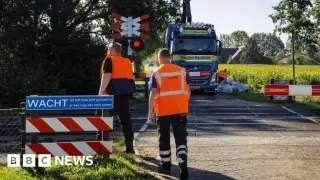
Suspected sabotage placed pipes and cables on tracks across central and northern Netherlands, triggering about 30 disruptions and closures of some level crossings, with services affected to Schiphol, Eindhoven and Utrecht; ProRail said the incident appeared deliberate and police, prosecutors and the AIVD launched an investigation as rail services gradually resumed; a Eurostar Amsterdam–Paris was delayed but not otherwise affected; no injuries reported.
A Cuban-born salsa instructor living in Petrozavodsk, Oemis Romagoza Durruthy, is identified by Deutsche Welle and partners as the alleged recruiter behind a disposable-agent network that sought to carry out arson and sabotage across at least four EU countries in 2024, via Telegram ads recruiting Latin Americans and others with military or logistical experience. Recruits were given tasks such as photographing sites and planning attacks; one Colombian recruit, Luis Alfonso Murillo Diosa, was sentenced in Romania to six years for attempted sabotage after being directed to target a waste facility and an oil well. At least a dozen people were recruited, with several detained and two already serving six-to-eight-year sentences; Lithuanian prosecutors publicly linked the plots to Russian military intelligence, and Lithuanian authorities issued an international wanted notice for Romagoza, who teaches dance in Russia and obtained citizenship in 2022. It remains unclear whether he continued recruiting after 2024, but authorities say suspected Russian sabotage activity in Europe has continued, with ongoing investigations across EU countries.
Bulgarian authorities are probing an overnight fire at EMCO’s ammunition storage site near Gorni Varpishta, with officials not ruling out outside interference after explosions left no injuries. EMCO calls the blaze sabotage, noting the facility had been inactive for months and recently inspected; this follows a prior fire at a nearby warehouse. The company, whose weapons are used by Ukraine, links the broader pattern of attacks on Bulgaria’s defence industry to saboteurs, amid prosecutors’ claims that owner Emilian Gebrev has been targeted by Russian agents.
A regional train carrying 186 passengers from Rouen to Caen derailed Friday evening in Cleon, Normandy, injuring 44 people, including an 18-year-old woman who was airlifted to Rouen University Hospital. Investigators found a piece of rail on the track and are examining whether sabotage caused the derailment; authorities cautioned that the circumstances are not yet known. The incident adds to a history of rail disasters cited for context as prosecutors and police pursue the inquiry.