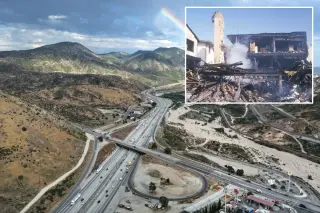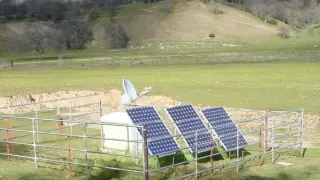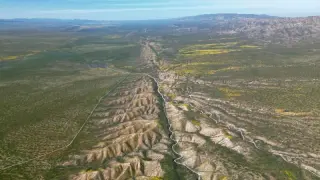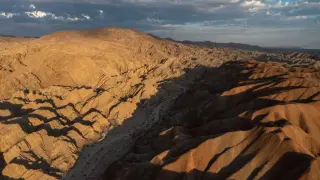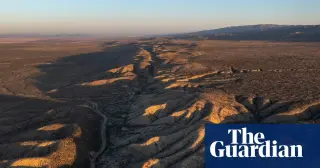
NASA’s Landsat imagery captures a vivid superbloom at Carrizo Plain National Monument along the San Andreas Fault in March 2026, sparked by a wet winter; researchers are combining satellite data with field spectroscopy to develop a global flower-monitoring system that could aid farmers, beekeepers, and land managers.
Scientists using a dense seismometer network tracked ultra-small, low-frequency earthquakes offshore to map a five-piece fault system where the San Andreas fault meets the Cascadia subduction zone, including a deep Pioneer fragment from the Farallon plate, which helps explain the unusually shallow 1992 quake and challenges prior boundary models; the work, published in Science, improves understanding of seismic hazards in this complex region.
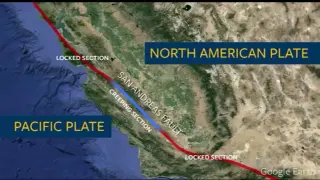
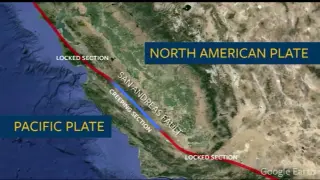
A long-lost oceanic plate fragment called the Pioneer Fragment is now stuck to the Pacific Plate at the Mendocino triple junction, moving northwest under North America and interacting with the Gorda Plate, increasing contact with the Cascadia subduction zone and potentially adding a previously unmodeled fault to regional earthquake risk models.
The piece examines why predicting earthquakes is so challenging, using California’s Parkfield Experiment on the San Andreas Fault as a focal point. Although scientists predicted a quake between 1985 and 1993, a magnitude-6.0 event occurred in 2004—11 years later—highlighting the inherent uncertainty of fault behavior. The article explains how fault geometry, subsurface properties, and limited historical data complicate forecasts, while noting advances in hazard maps, sensor networks, InSAR, GPS, and AI that improve risk assessment and move toward a practical (though not perfectly precise) seismic 'crystal ball.'
A recent study using satellite imagery of Myanmar's Sagaing Fault suggests that future earthquakes on similar strike-slip faults, like California's San Andreas Fault, could be larger and more unpredictable than past events, emphasizing the need for updated, physics-based seismic models for better hazard prediction.
A new study suggests that the San Andreas Fault could produce a larger and more unpredictable earthquake than previously thought, based on insights from Myanmar's recent devastating earthquake, which revealed that faults can rupture over larger areas than expected, challenging existing seismic models.
Recent research suggests that future earthquakes on the San Andreas Fault may not follow past patterns, as exemplified by the unexpected rupture length of the Myanmar earthquake, indicating that current seismic models need to incorporate fault activity history for more accurate predictions.
A recent study suggests that the upcoming 'Big One' earthquake in California is unpredictable in its specifics, with past quakes like Myanmar's 7.7 magnitude event offering limited direct insights. Scientists emphasize the importance of modeling potential scenarios to better prepare for various earthquake magnitudes and impacts, acknowledging that the next major quake could differ significantly from historical events.
Recent research shows that the next major earthquake on California's San Andreas fault may not follow historical patterns, as exemplified by a surprising long rupture in Myanmar's similar fault, indicating that earthquakes can behave unpredictably and vary significantly in size and scope.
A study comparing the Myanmar earthquake to potential scenarios on California's San Andreas fault suggests that future mega-earthquakes may not replicate past events exactly, with possibilities ranging from smaller, segmented quakes to a larger, more destructive rupture, emphasizing the unpredictability and complexity of seismic activity.
A study suggests that a section of the San Andreas fault in California, known as Parkfield, may be exhibiting unusual behavior, indicating a potential for a significant earthquake. The lead author of the study, Luca Malagnini, acknowledges the difficulty in predicting earthquakes but expresses hope for identifying early signs. While the possibility of scientifically predicting earthquakes remains uncertain, ongoing research aims to improve understanding and potentially mitigate future earthquake-related disasters.
A section of the San Andreas fault known as Parkfield in Central California, where earthquakes occur regularly, may be showing signs of an imminent earthquake. New research suggests that a distinct signal related to the opening and closing of cracks beneath the subsurface may precede seismic activity. While the fault segment is not currently exhibiting this signal, researchers are closely monitoring it for potential clues to predict the next quake, which could help save lives. The study's lead author, Luca Malagnini, believes that the next earthquake may occur this year, but the epicenter may not be in the same place as the 2004 quake.
California's annual statewide earthquake drill, the Great ShakeOut, took place on Thursday, with millions of people participating in the earthquake safety drill. The drill aims to educate the public about earthquake hazards and safety practices, emphasizing the importance of knowing how to protect oneself during an earthquake. California, situated on the San Andreas Fault, is particularly prone to earthquakes, making the drill crucial for residents. The Great ShakeOut also includes instructions for what to do if an earthquake strikes while outdoors or in a car.
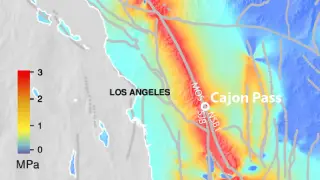
The southern section of California's San Andreas Fault, known as the southern San Andreas Fault (SSAF), has not experienced a major earthquake in over 300 years, despite being overdue for one. Scientists from San Diego State University and UC San Diego's Scripps Institution of Oceanography have discovered that the low water levels of the Salton Sea, a remnant of a larger prehistoric lake, could explain the reduced seismic activity. Computer modeling revealed that the presence of a large lake can cause the Earth's crust to bend and increase fluid pressure, making earthquakes more likely. However, the drought-like state of the Salton Sea is just one factor in the complex seismic activity of the region, and earthquakes along the SSAF are still expected in the future.
The drying of the Salton Sea in Southern California has reduced pressure on the San Andreas Fault and delayed a major earthquake, according to a recent study. The weight of the lake on the Earth's crust changes the stress in the area of the fault. Historically, six of the past seven major earthquakes in Southern California over the last 1,000 years occurred when the ancient Lake Cahuilla, located where the Salton Sea is now, was either filling or at its fullest. However, rapidly refilling the lake may increase the likelihood of an earthquake.