
Tag

Sheeppox

All articles tagged with #sheeppox

Medieval Manuscripts Reveal 3,700-Year History of Sheeppox Virus
science19 days ago

Medieval Manuscripts Reveal 3,700-Year History of Sheeppox Virus

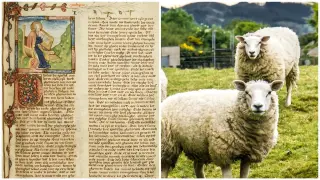
Researchers at University College Dublin identified ancient sheeppox virus DNA in the York Gospels and other medieval manuscripts, revealing that the pathogen has infected livestock for over 3,700 years. Published in Science Advances, the study shows that parchment made from infected animal skins preserved viral genetic material, offering insights into the virus's evolution and its ongoing threat to global agriculture.
Medieval Parchment Reveals 3,500-Year History of Sheeppox Virus
science1 month ago

Medieval Parchment Reveals 3,500-Year History of Sheeppox Virus

Researchers at University College Dublin extracted sheeppox virus DNA from medieval manuscripts and Bronze Age sheep teeth, reconstructing the pathogen’s evolution over 3,500 years. Published in Science Advances, the study identifies 21 ancient genomes, revealing that the virus diverged from other capripoxviruses between 11,500 and 3,700 years ago, coinciding with animal domestication. The findings suggest medieval parchment preserves biological records of livestock disease, offering insights into viral stability and historical outbreaks across Eurasia.

Ancient Parchment Reveals 3,700-Year History of Sheeppox Virus
science1 month ago

Ancient Parchment Reveals 3,700-Year History of Sheeppox Virus

Researchers at University College Dublin have reconstructed the evolutionary history of the sheeppox virus over 3,700 years by extracting DNA from medieval parchment and Bronze Age sheep teeth. Published in Science Advances, the study identifies 21 ancient viral genomes, revealing that the virus diverged from related capripoxviruses between 11,500 and 3,700 years ago. The findings suggest that medieval manuscripts serve as biological archives of livestock disease, with viral traces found in famous texts like the York Gospels and the Corpus Glossary. The research highlights the virus's genetic stability over millennia and its continued impact on modern livestock, such as recent outbreaks in Greece.