Tag

Stonehenge

All articles tagged with #stonehenge

Stonehenge Altar Stone Origin Remains Unsolved After Scottish Quarry Search Fails
science10 hours ago

Stonehenge Altar Stone Origin Remains Unsolved After Scottish Quarry Search Fails

Researchers have failed to identify the specific source of Stonehenge’s six-ton Altar Stone after ruling out leading candidates in northeastern Scotland. A new study confirms the stone’s mineral composition does not match rocks from the Orcadian Basin, contradicting a 2024 hypothesis that linked it to that region. While the exact origin remains unknown, the investigation has refined the geological profile of the slab, allowing future searches to exclude previously suspected areas. The mystery persists because the stone’s true origin would reveal the logistical capabilities of Neolithic builders who transported materials across hundreds of miles.
science9 days ago

Geologists rule out key Scottish sites for Stonehenge’s Altar Stone, narrowing search

A new study in the Journal of the Geological Society has ruled out several potential sources for Stonehenge’s six-ton Altar Stone in northeast Scotland. While earlier research pointed to the Orcadian Basin, the latest analysis found no exact geological match, leaving the stone’s origin unresolved but providing a clearer profile for future searches.

New Geological Analysis Fails to Confirm Northeast Scotland as Source of Stonehenge’s Altar Stone
science17 days ago

New Geological Analysis Fails to Confirm Northeast Scotland as Source of Stonehenge’s Altar Stone

A new study published in the Journal of the Geological Society on November 5, 2026, concludes that the six-tonne Altar Stone at Stonehenge likely did not originate in northeast Scotland. While a 2024 study suggested a match with the Orcadian Basin, this latest research found no exact geological match among 70 samples from the region, leaving the stone’s origin unresolved.

Altar Stone Origin Confirmed in Scotland, Yet Transport Method Remains Unresolved

Altar Stone Origin Confirmed in Scotland, Yet Transport Method Remains Unresolved

New geological analysis confirms the Altar Stone at Stonehenge originated in northeast Scotland, specifically the Orcadian Basin near Caithness, overturning previous theories that linked it to Wales. While the stone’s mineral composition is now clear, the method used to transport the six-tonne slab across hundreds of kilometers to southern England remains a mystery. Recent studies suggest glaciers likely did not carry the stone, implying that Neolithic communities undertook a massive logistical effort, potentially involving maritime routes, to move it.

New Geological Data Confirms Stonehenge’s Altar Stone Origin in Scotland, Deepening Transport Mystery
science19 days ago

New Geological Data Confirms Stonehenge’s Altar Stone Origin in Scotland, Deepening Transport Mystery

New research confirms Stonehenge’s Altar Stone originated in northeast Scotland, not Wales, as previously believed. While the stone’s mineral fingerprint points to the Old Red Sandstone of the Orcadian Basin, specifically near Caithness, the method of transport remains unresolved. Two recent studies suggest glaciers likely did not carry the six-tonne slab to southern England, leaving human transportation as the primary explanation. This implies a massive logistical effort by Neolithic communities, potentially involving maritime routes, to move the stone across hundreds of kilometers.

1960s Theory: Stonehenge Was a Lunar Eclipse Computer
history2 months ago

1960s Theory: Stonehenge Was a Lunar Eclipse Computer

In 1966, Boston astronomer Gerald Hawkins proposed that Stonehenge was an astronomical observatory designed to predict lunar eclipses. Using early IBM computers, he argued that 56 holes in the monument’s outer circle served as a counting device for lunar cycles. Although the theory silenced debate for decades, modern archaeology has rejected it, noting that Stonehenge was built over 1,500 years and its alignments were imprecise. Current research suggests the site celebrated solar and lunar movements rather than functioning as a predictive instrument.

Ancient DNA overturns Bronze Age stereotypes: Stonehenge-era shaman identified as female
archaeology4 months ago

Ancient DNA overturns Bronze Age stereotypes: Stonehenge-era shaman identified as female

Genetic testing of the 4,000-year-old burial known as the Upton Lovell Shaman near Stonehenge shows the individual was female (XX chromosomes), not male, challenging long-held views of Bronze Age metalworkers and leaders. The richly equipped grave—including goldworking tools, a touchstone, and ceremonial objects—suggests she was a high-status metalworker and shaman. The find, highlighted ahead of a new exhibition at the Francis Crick Institute, broadens our understanding of women's roles in Early Bronze Age society.

Ice and ingenuity: Glaciers and ancient people moved Stonehenge's Altar Stone
science5 months ago

Ice and ingenuity: Glaciers and ancient people moved Stonehenge's Altar Stone

A Curtin University-led study using geological analysis and ice-sheet modeling suggests Stonehenge's Altar Stone originated in northeast Scotland and was carried by glaciers about 200 miles to Dogger Bank, after which prehistoric communities hauled it roughly 250 more miles to Wiltshire, for a total journey of about 450 miles — implying a carefully planned, multi-stage transport rather than ice doing the whole trek.

Nearby hillside reveals a Neolithic 'prototype' of Stonehenge, researchers say
world-news5 months ago

Nearby hillside reveals a Neolithic 'prototype' of Stonehenge, researchers say

Archaeologists have unearthed a nearby early version of Stonehenge on a hillside a few miles from the iconic monument. Excavations conducted 2015–2017 and years of analysis suggest it was a precursor to Stonehenge, shedding light on the late-Neolithic ceremonial landscape and offering context for why the famous circle was built. The discovery comes as scholars discuss Stonehenge’s possible purposes, with sunrise-ritual implications noted, and broader public interest remains high in the area near Bulford and Salisbury Plain.

Wiltshire discovery hints at Stonehenge's prehistoric precursor
science5 months ago

Wiltshire discovery hints at Stonehenge's prehistoric precursor

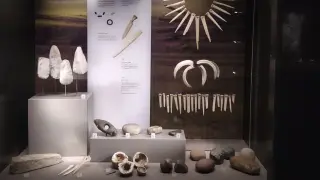
Archaeologists in Wiltshire have uncovered a 5,000-year-old wooden structure at Bulford that may have been a prototype for Stonehenge. Two wooden poles stood 120 meters apart and align with the midsummer sunrise and midwinter sunset, suggesting early astronomical knowledge. Radiocarbon dating places the site about 5,000 years old, roughly 500 years before Stonehenge’s stones were erected. Artifacts such as pottery, bone, charcoal, flints, and a rare disc-shaped knife hint at communal solstice gatherings within a broader Neolithic landscape around Stonehenge.

5,000-year-old Bulford site reveals an earlier wooden precursor to Stonehenge
science5 months ago

5,000-year-old Bulford site reveals an earlier wooden precursor to Stonehenge

Archaeologists have uncovered a 5,000-year-old, simpler precursor to Stonehenge in Bulford, consisting of two wooden posts positioned 120 meters apart and aligned with summer solstice sunrise and winter solstice sunset. Radiocarbon dating and artefacts like pottery and flint tools suggest prehistoric gatherings, implying the builders of Stonehenge may have been linked to, or based in, Bulford long before the monument’s stones were erected.