Tag

Neolithic

All articles tagged with #neolithic

Nearby hillside reveals a Neolithic 'prototype' of Stonehenge, researchers say
world-news22 days ago

Nearby hillside reveals a Neolithic 'prototype' of Stonehenge, researchers say

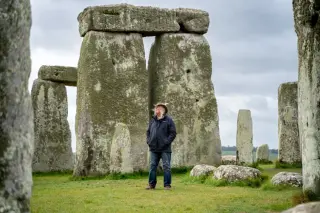
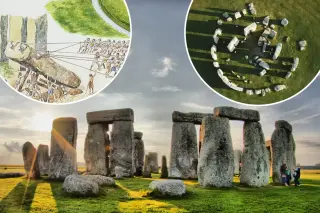
Archaeologists have unearthed a nearby early version of Stonehenge on a hillside a few miles from the iconic monument. Excavations conducted 2015–2017 and years of analysis suggest it was a precursor to Stonehenge, shedding light on the late-Neolithic ceremonial landscape and offering context for why the famous circle was built. The discovery comes as scholars discuss Stonehenge’s possible purposes, with sunrise-ritual implications noted, and broader public interest remains high in the area near Bulford and Salisbury Plain.

Wiltshire discovery hints at Stonehenge's prehistoric precursor
science23 days ago

Wiltshire discovery hints at Stonehenge's prehistoric precursor

Archaeologists in Wiltshire have uncovered a 5,000-year-old wooden structure at Bulford that may have been a prototype for Stonehenge. Two wooden poles stood 120 meters apart and align with the midsummer sunrise and midwinter sunset, suggesting early astronomical knowledge. Radiocarbon dating places the site about 5,000 years old, roughly 500 years before Stonehenge’s stones were erected. Artifacts such as pottery, bone, charcoal, flints, and a rare disc-shaped knife hint at communal solstice gatherings within a broader Neolithic landscape around Stonehenge.

Ancient Britons Likely Haul 6-Ton Stone 435 Miles to Stonehenge, New Study Finds
science25 days ago

Ancient Britons Likely Haul 6-Ton Stone 435 Miles to Stonehenge, New Study Finds

Curtin University researchers conclude Stonehenge’s central Altar Stone, weighing about six tons, originated in northeast Scotland and was moved to Wiltshire by deliberate human transport rather than glaciers. Glacial routes to southern England are unlikely, suggesting a staged journey that combined overland hauling with rivers or coastal transport, reflecting planning and cooperation in Neolithic Britain; future work aims to pinpoint the stone’s exact source.

Ancient Slovakia ditch hides 7,000-year-old headless skeletons, hinting at Neolithic burial rites
archaeology1 month ago

Ancient Slovakia ditch hides 7,000-year-old headless skeletons, hinting at Neolithic burial rites

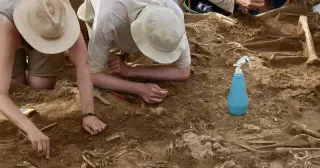
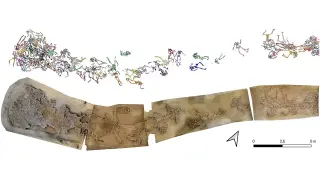
In a Neolithic LBK settlement at Vráble, Slovakia, archaeologists uncovered a ditch containing dozens of headless skeletons, including a mass burial of at least 77 decapitated bodies and a skull from a child. Analyses suggest the skulls were removed with sharp tools and that beheadings occurred postmortem as part of a ritual rather than a mass killing. The find, dating to about 5250–4950 BCE, hints at head-focused ancestor worship or other social practices within three neighboring LBK neighborhoods; researchers caution that more excavation is needed to understand whether violence played a role.

Stonehenge's Altar Stone: a Neolithic trek across Britain
archaeology1 month ago

Stonehenge's Altar Stone: a Neolithic trek across Britain

A Curtin University–led study links Stonehenge’s Altar Stone to Caithness, Scotland, using mineral fingerprints and ice‑sheet modeling to show glaciers likely played only a limited role; the six‑ton block would have required a staged, human‑led journey across land and waterways to Salisbury Plain, highlighting coordinated Neolithic transport across regions rather than a purely glacial transfer.

Morocco’s Ancient Genomes Reveal a Mosaic Path to Farming
science2 months ago

Morocco’s Ancient Genomes Reveal a Mosaic Path to Farming

New ancient DNA from three Moroccan sites shows the Maghreb’s shift from hunting-gathering to farming was multi-directional and layered: European Neolithic farmer ancestry reached Morocco around 7,400 years ago, indigenous hunter-gatherers adopted farming while retaining local genetics, and later Fertile Crescent pastoralists added new lineages, painting a mosaic rather than a single-wave spread of farming.

Caves Unveil Green Sahara From 8,000 Years Ago
science4 months ago

Caves Unveil Green Sahara From 8,000 Years Ago

Scientists analyzing stalagmites from caves south of the Atlas Mountains in southern Morocco find rainfall persisted from 8,700 to 4,300 years ago, signaling a greener Sahara; uranium-thorium dating and oxygen isotope analysis tie the wetter period to tropical moisture plumes, and archaeological records show Neolithic communities expanding there as grazing lands widened.

Ancient DNA shows farming spread into Europe came through women joining hunter-gatherer groups
archaeology4 months ago

Ancient DNA shows farming spread into Europe came through women joining hunter-gatherer groups

New ancient-DNA findings from Belgium, the Netherlands and Rhine-Meuse wetlands reveal that Neolithic farming spread into hunter-gatherer Europe largely via women marrying into forager communities, supporting a permeable frontier model. Over time, later migrations such as Corded Ware from the steppe reshaped the region’s ancestry, leading to populations with mixed hunter-gatherer and farmer lineages rather than a simple farmer replacement.

Stone-Age Woman Buried with Male Tools Signals Fluid Neolithic Roles in Hungary
science4 months ago

Stone-Age Woman Buried with Male Tools Signals Fluid Neolithic Roles in Hungary

A study of 125 skeletons from two Neolithic cemeteries in eastern Hungary (circa 5300–4650 BCE, about 7,000 years ago) shows that men and women generally had distinct burial patterns, but some individuals were buried in ways that did not align with their biological sex. Female burials were often on the left with shell bead belts, and male burials on the right with polished stone tools, yet an older female’s toes indicated a kneeling pattern more like the men’s. The researchers say these exceptions reveal that gender roles were flexible and shaped by multiple factors in this Stone Age society.

Northwestern Europe’s Hunter-Gatherers Outlasted Farming by Millennia, DNA Reveals
science4 months ago

Northwestern Europe’s Hunter-Gatherers Outlasted Farming by Millennia, DNA Reveals

Ancient DNA from individuals in the Belgium–Netherlands region dating 8,500–1,700 BCE shows hunter-gatherers persisted thousands of years after farming arrived (~4,500 BCE), with only limited genetic input from incoming farmers. The farmer influx was largely women marrying into local communities, enabling a gradual cultural transition rather than a rapid population turnover, and hunter-gatherer ancestry remained common until about 2,500 BCE when new populations fully mixed. The study, part of a Reich Lab collaboration, was published in Nature and underscores the strong, gender-skewed role in knowledge transfer during Europe’s Neolithic transition.

DNA reveals tangled kinship in 5,500-year-old Gotland gravesite
archaeology4 months ago

DNA reveals tangled kinship in 5,500-year-old Gotland gravesite

A DNA analysis of 5,500-year-old burials at Ajvide on Gotland, Sweden, uncovers complex kinship networks among Neolithic hunter-gatherers: many graves held distant relatives rather than immediate family, including a teen girl whose father’s bones were placed atop her grave, with bones moved from elsewhere; the study suggests kinship beyond the immediate family shaped burial practices.