Tim Cook says the MacBook Neo’s demand has been ‘off the charts’ since its March launch, surpassing expectations and driving a record number of first-time Mac buyers, while supply remains constrained with multi-week delivery estimates.
Apple said memory costs rose in the March quarter and will be significantly higher in the June quarter and beyond, driven by AI-server demand and global supply constraints. The impact is being offset by selling existing inventory, and Apple is evaluating a range of options as inventory runs down and costs continue to rise.
Apple posted all-time high iPhone sales helping to push quarterly revenue to $144 billion, with strong demand across China, Europe, the Americas, Japan, and a quarterly India record; wearables and Mac sales declined while Tim Cook said the company is in 'supply chase mode' to meet iPhone demand. Details on the Google Gemini AI partnership weren't disclosed. Apple plans about $16 billion in capex next year, and the stock dropped around 10% after the results.
Apple's CEO Tim Cook forecasts holiday quarter iPhone sales and revenue that surpass Wall Street estimates, driven by strong demand for iPhone 17 models despite supply constraints and delays in China. The company expects double-digit iPhone sales growth and a 10-12% increase in overall revenue for Q1 2026, with particular strength in base and Pro models, while addressing ongoing supply issues and trade tensions.
Apple CEO Tim Cook indicated that demand for the iPhone 17 and iPhone 17 Pro is stronger than expected, leading to supply constraints, especially at the high and entry levels, while the iPhone Air appears to be moving towards end-of-cycle production. Despite limited sales data, early signs suggest robust interest in the new models, with Apple reporting increased revenue in Q4 2025.
Apple reports strong global demand for its latest iPhones, including the new iPhone Air and upgraded iPhone 17 models, despite supply constraints and a slight miss in quarterly sales estimates. The company expects a record-breaking holiday season with revenue potentially up 12%, driven by robust sales in China and the US. However, tariffs and supply chain issues remain challenges, with Apple working to meet demand amid ongoing trade tensions.
Apple is expected to launch the M5 MacBook Pro in October amid supply constraints of the M4 models, with potential staggered releases of M5, M5 Pro, and M5 Max versions, possibly delaying the introduction of OLED MacBook Pro models until 2027, and the launch may be announced via press release rather than a traditional event.
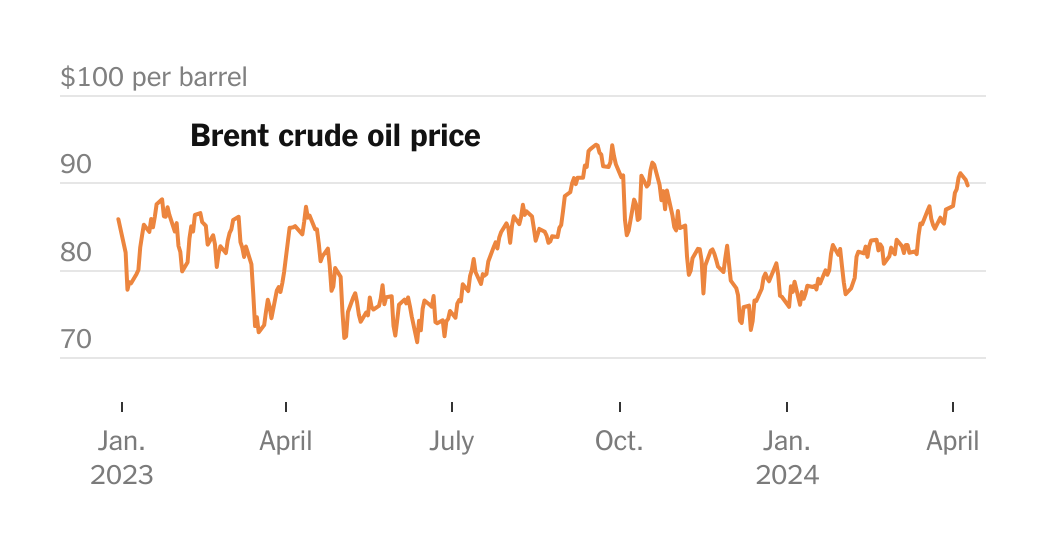
Oil prices have surged recently due to concerns over supplies and geopolitical risks, such as conflicts in Ukraine and the Middle East, with the price of Brent crude oil rising over 20% since mid-December. This increase could complicate efforts to curb inflation and lead to higher gasoline prices during the summer driving season in the United States, potentially impacting the Biden administration's election prospects. Despite the possibility of a short-term price retreat, strong demand and production cuts by Saudi Arabia and its allies have raised concerns about a potential supply squeeze.
Cocoa prices surged to a record-breaking $10,030 per metric ton, driven by supply constraints including hotter temperatures in Ivory Coast, the world's largest cocoa producer, and an outbreak of cacao swollen shoot virus. The commodity has soared nearly 138% this year, with strong chocolate demand in countries like the U.S. contributing to the price hike.
JPMorgan warns that Nvidia's stock price could react negatively to a blowout earnings report, as it may signal improving supply and potential inventory correction, leading to a lose-lose situation in the short term. Despite high investor expectations, exceeding them could still result in a negative stock reaction, with risks skewed to the downside following the stock's massive surge over the past year.
The FDA's website indicates limited availability of higher doses of Eli Lilly's diabetes drug, Mounjaro, due to increased demand, with intermittent back orders expected through early March 2024. The company acknowledges the potential disruption in treatment regimens and is working urgently to address the situation. The supply constraints are attributed to soaring demand for GLP-1 agonists, used for diabetes and weight loss, affecting drugmakers like Lilly and Novo Nordisk. Other Mounjaro doses are currently in stock, and both companies are striving to boost production to meet the strong demand.
Sanofi anticipates limited supply of its infant RSV antibody Beyfortus, co-developed with AstraZeneca, in the first quarter of this year due to overwhelming demand, with plans to boost production but uncertainty about the extent of progress that can be made in 2024. CEO Paul Hudson highlighted efforts to address manufacturing bottlenecks and increase capacity to tackle supply constraints.
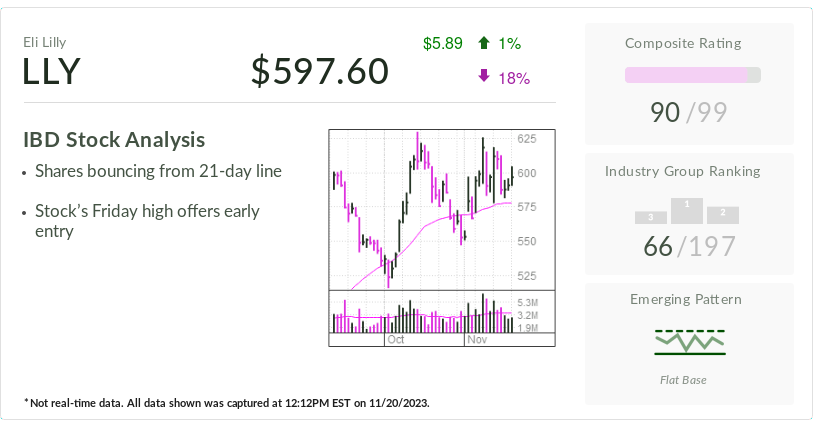
Eli Lilly's stock (LLY) is forming a new flat base after the FDA approved its weight-loss drug, Zepbound. The drug is being offered at a 20% discount compared to its rival, Wegovy, which could drive better insurance coverage and patient uptake. Despite supply constraints, analysts expect Eli Lilly's weight-loss drug sales to increase significantly. The company is also working on other late-stage assets, including an Alzheimer's treatment and an eczema drug. Eli Lilly's stock has a strong performance rating and recently joined SwingTrader.
Tesla has once again reduced the prices of its popular models in the US as part of its efforts to boost demand and take advantage of improved supply conditions. The base Model 3 now starts at $38,990, while the long-range version is priced at $45,990. The performance version of the Model 3 saw a $2,250 price cut, bringing it down to $50,990. The Model Y also received price reductions, with the long-range version now priced at $48,490 and the performance version at $52,490. Tesla's price cuts have helped offset the impact of higher interest rates and inflation but have also affected profitability. The company will provide an update on the impact of these price cuts on earnings when it reports its third-quarter results on October 18.
Apple's flagship iPhone 15 Pro Max is facing manufacturing issues, with both LG Display and BOE struggling to gain approval to produce screens for the model due to problems with the new slim bezels and the exclusive periscope camera. Production issues also extend to the new 48-megapixel cameras on the iPhone 15 and iPhone 15 Plus. Apple is focusing production on the iPhone 15 Pro to maintain a balance between Pro and non-Pro models. Despite the challenges, Apple is expected to announce all iPhone 15 models in September, but there are uncertainties about when they will go on sale.