Tag

Toi 791

All articles tagged with #toi 791

Cosmic cotton candy: two Jupiter-sized exoplanets revealed as featherweight 'super-puffs'
science4 days ago

Cosmic cotton candy: two Jupiter-sized exoplanets revealed as featherweight 'super-puffs'

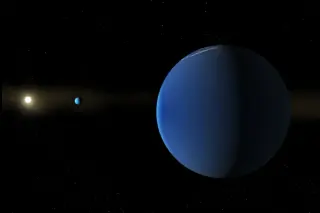
Astronomers have identified two Jupiter-sized exoplanets, TOI-791 b and TOI-791 c, about 1,100 light-years away, that are ultralow-density 'super-puffs,' with densities far lower than Jupiter and likely hydrogen/helium atmospheres. Their puffiness, comparable to shaving foam or cotton candy, makes them some of the lightest known planets and challenges standard formation theories. Observations from Antarctica helped determine their densities, and their orbits may be in a mean-motion resonance, implying formation in gas-rich regions farther from their star.
Jupiter-Sized Super-Puffs Defy Density, Hint at New Planetary Formation
space16 days ago

Jupiter-Sized Super-Puffs Defy Density, Hint at New Planetary Formation

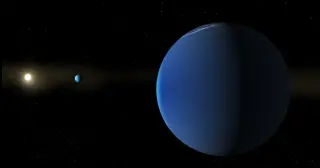
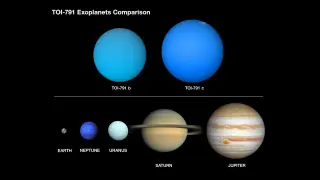
NASA’s TESS revealed two Jupiter-sized exoplanets orbiting TOI-791, about 1,110 light-years away in the Volans constellation, that are ‘super-puffs’ with densities far lower than cotton candy. They are the lightest known planets for their size, probably hydrogen–helium worlds whose composition will be clarified by Webb Space Telescope follow-up. Formed in gas-rich disks and later stripped down, these rare planets are among fewer than 40 super-puffs out of about 6,300 confirmed exoplanets.

NASA's TESS Spots Two Ultra-Low-Density Exoplanets in One System
science18 days ago

NASA's TESS Spots Two Ultra-Low-Density Exoplanets in One System

NASA's TESS has identified two Jupiter-size exoplanets in the same star system that are astonishingly low in density—about 3% and 5.9% of Jupiter's mass—earning them the label of the puffiest planets. Their large radii combined with low masses produce cotton-candy-like densities, and they exhibit unusually long orbits with mutual gravitational effects that alter transit timings, enabling mass estimates. The discovery, based on seven years of data (1,122 days of observations), offers a rare chance to study their atmospheres and how such ‘cotton candy’ worlds form.