A kottke.org post curates discussion suggesting AI (including Claude and ChatGPT) could be the next evolutionary phase, referencing Richard Dawkins and the Turing Test, while linking to an UnHerd piece; the original is paywalled but the dialogue continues in the comments.
In a Nature correspondence, Quattrociocchi, Capraro, and Marcus argue that Chen et al.’s claim that success in behavioural tests (including Turing-test variants) demonstrates artificial general intelligence is problematic. They present three grounds for skepticism, stressing that such performance reflects statistical pattern matching or task-specific competence rather than true general intelligence or understanding, and warn against equating behavioural mimicry with AGI.
The article discusses the complexities and debates surrounding the definition of Artificial General Intelligence (AGI), emphasizing that current AI systems, including large language models, are far from achieving true cognitive versatility comparable to humans. It critiques traditional benchmarks like the Turing Test, explores the biological and philosophical aspects of consciousness and emotions, and highlights the ongoing challenge of defining and measuring AGI in practical terms, suggesting that progress is more about moving goalposts than reaching a definitive standard.
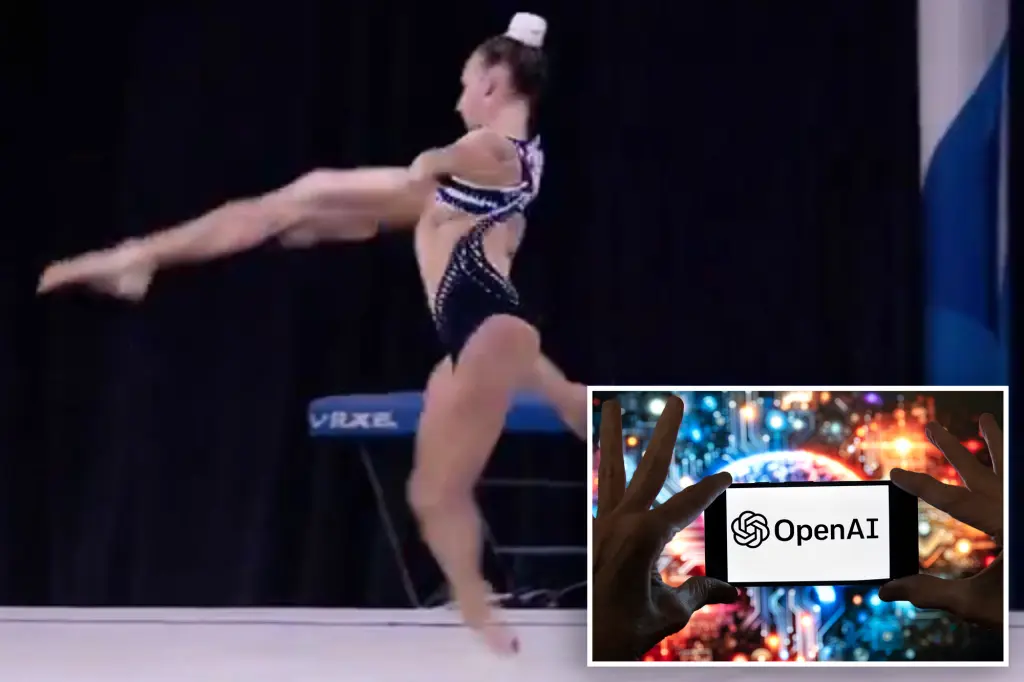
OpenAI's video generator, Sora, has faced criticism after producing a disturbing video of a gymnast performing unnatural and bizarre movements, highlighting the tool's current limitations in simulating realistic human physics. The video, which included unsettling visuals like a face replaced by a third leg, underscores the challenges generative AI faces in understanding and replicating complex human mechanics. Despite improvements over previous models, experts note that AI still struggles with tasks requiring common sense and realistic physics simulation.
A viral video featured a "reverse Turing test" where AI models, each portraying historical figures, identified a human imposter among them. The AI agents, including GPT-4 Turbo and Claude-3 Opus, successfully detected the human based on a lack of nuanced responses. Experts debate the validity and implications of such tests for assessing machine intelligence.
Neurobiologists Yossi Yovel and Oded Rechavi from Tel Aviv University have proposed the "Doctor Dolittle challenge" for AI-based language models to communicate with animals. The challenge requires the AI to use the animal's own communicative signals, apply them in various behavioral contexts, and elicit a measurable response from the animal. While progress has been made, such as creating a robotic bee that can recruit other bees, the challenge remains in understanding the full complexity of animal communication and the limitations of human language. The neurobiologists encourage scientists to apply AI to decipher animal communication, even if full human-like communication may never be achieved.
The rapid progress of large language models (LLMs) like ChatGPT has led to questions about whether they can think and understand. However, careful philosophical analysis and argument suggests that they cannot. While passing the Turing test may show that an AI has achieved thought and understanding, it does not necessarily mean it is conscious. Consciousness must have evolved because it made a behavioural difference, and systems with consciousness must behave differently and survive better than those without. As we learn more about the brain's detailed workings, we will precisely identify which areas of the brain embody consciousness.
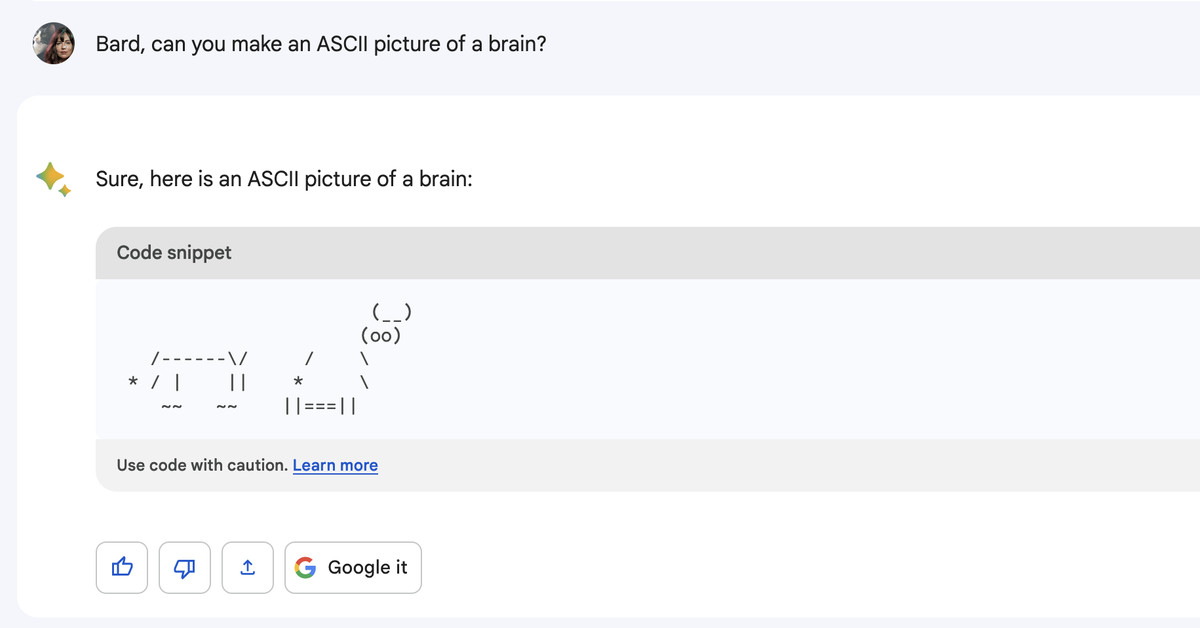
A writer conducted an experiment to see if Google's large language model, Bard, could identify the letter "e" in the word "ketchup." The experiment revealed that language is not the same as knowledge and that intelligence precedes language. While chatbots like Bard can produce ad copy, they lack the intelligence and understanding of the world that humans possess. The article suggests that chatbots can be useful in illuminating the things about human intelligence that we take for granted.
OpenAI's GPT5, the next generation of large language models, is rumored to be released by the end of 2023. It is expected to have 100 times more parameters than GPT-3, use 200 to 400 times more computing, and potentially achieve artificial general intelligence (AGI), the ability to perform any task that a human can. AGI is a controversial and elusive concept, but achieving it could have far-reaching implications for scientific discovery, education, and problem-solving. The Turing test is one of the most famous tests for AGI, but some experts propose alternative tests that focus on self-directed learning and problem-solving.