
Mortgage Rates Hold Steady at 7.17% as Oil Prices Ease Bond Yields
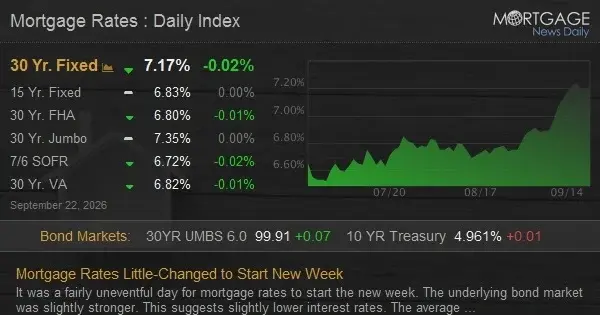
US 30-year fixed mortgage rates remained largely unchanged at 7.17% on Monday, September 21, 2026, following a recent Federal Reserve rate hike. According to Mortgage News Daily, the slight dip in rates was driven by lower oil prices, which strengthened the bond market. This stability marks a pause in the upward trend of borrowing costs, which had recently reached their highest levels since January 2025.
Key points
- The average top-tier 30-year fixed mortgage rate decreased by 0.01% to 7.17%, while the 15-year fixed rate remained unchanged at 6.83%.
- Mortgage News Daily attributes the slight rate decline to a stronger bond market, which was influenced by lower oil prices.
- Current mortgage rates are aligned with levels seen before the Federal Reserve’s recent rate hike, indicating a temporary stabilization in borrowing costs.
- The 10-year US Treasury yield stood at 4.964%, reflecting the broader market sentiment that supports the current mortgage rate environment.
Background
This stability follows a period of rising mortgage costs, with 30-year rates previously peaking at 7.2% in September 2026, the highest in 18 months. The Federal Reserve recently raised its policy rate due to persistent inflation and strong economic growth, signaling a shift away from ultra-low rates. Housing affordability has become a critical issue, with nearly half of US metro areas requiring approximately $100,000 in annual income to qualify for a mortgage on a median-priced home. These rising costs have strained buyers and influenced political discourse ahead of midterm elections, as policymakers grapple with the affordability squeeze.
Why it matters
The stabilization of mortgage rates offers a brief respite for potential homebuyers and existing homeowners, but the underlying drivers of high rates, including inflation and Federal Reserve policy, remain unresolved. This pause may influence housing market dynamics, as buyers and sellers adjust to the new normal of elevated borrowing costs. Additionally, the link between oil prices and bond markets highlights the interconnectedness of global economic factors in shaping domestic housing conditions.
What to watch
Market participants will monitor oil prices and bond market movements for further signals on mortgage rate trends. The Federal Reserve’s future policy decisions will also be critical in determining whether rates continue to rise or stabilize. Housing affordability metrics and consumer sentiment will likely remain key indicators of the broader economic impact of these rate changes.
- Mortgage Rates Little-Changed to Start New Week Mortgage News Daily
- Weeks Before the Midterms, Almost Everything Is Getting More Expensive WSJ
- Mortgage Rates Today, September 22, 2026: 30-Year Refinance Rate Rises 4 Basis Points Norada Real Estate Investments
- Seattle housing market braces for ‘short-term pain’ The Seattle Times
- With mortgage rates on the rise, Twin Cities buyers already in retreat Star Tribune
Want the full story? Read the original reporting
Read on Mortgage News Daily