
Gut Microbial Genetic Variants Linked to 69 Host Health Traits
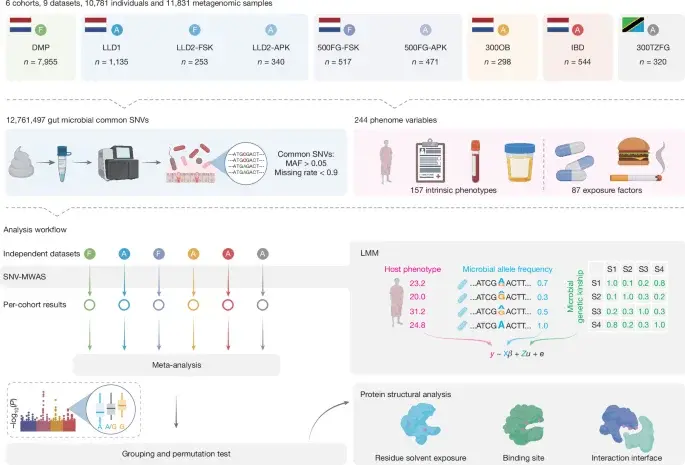
A large-scale study identified 940 associations between gut microbial genetic variants and human health factors, revealing new biological connections at the base-pair level.
Key points
- Researchers analyzed 12.8 million single-nucleotide variants in gut bacteria across 10,781 individuals from six cohorts.
- The study linked these genetic variants to 244 host phenotypes, including age, sex, and metabolic parameters.
- 940 independent associations were found across 69 host factors, with 810 linked to intrinsic factors and 130 to exposures.
- A specific variant in Faecalibacterium prausnitzii was associated with age, affecting a protein that binds glutathione.
- Results are available in an online catalogue to support future hypothesis generation and strain-level functionality research.
Background
Recent studies have highlighted the gut microbiome's role in chronic diseases, such as lung cancer risk and Parkinson's symptoms. Previous research also showed that diet and microbial interactions influence gut dominance, but this new study focuses on within-species genetic diversity rather than just species composition.
Why it matters
This research moves beyond species-level analysis to strain-level genetic variation, offering a more precise understanding of how microbial genetics influence human health and disease mechanisms.
What to watch
The online catalogue of summary statistics will aid future research in understanding strain-level functionality and developing microbiome-based interventions for chronic diseases.
Want the full story? Read the original reporting
Read on Nature