
ALMA Imaging Reveals Persistent Hotspots and Irregular Surface on Betelgeuse
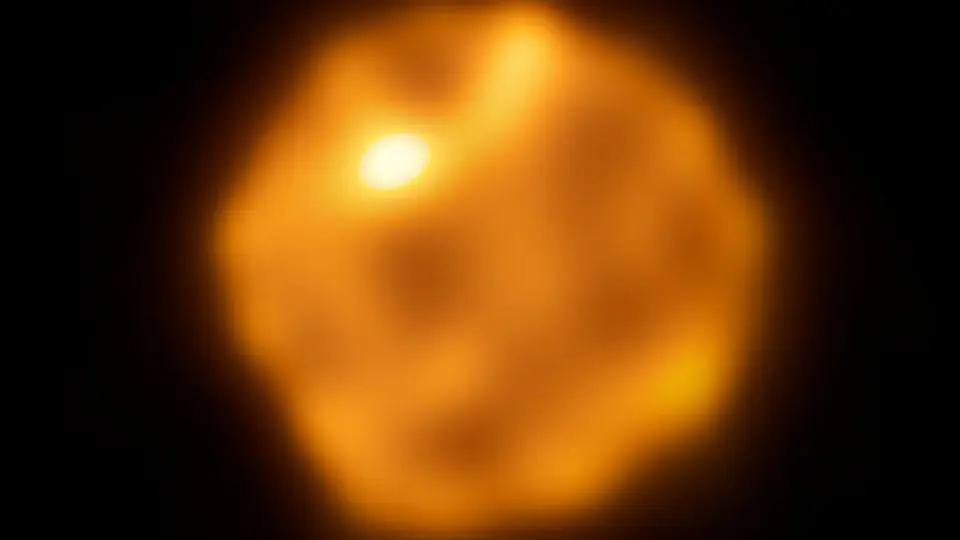
Astronomers using the Atacama Large Millimeter/submillimeter Array (ALMA) have captured the most detailed view yet of Betelgeuse's surface, revealing persistent hotspots and a non-spherical, corrugated atmosphere. The 2023 observations show that a bright northeastern hotspot has remained in the same location for at least seven years, challenging current models of stellar convection. These findings provide new insights into the turbulent dynamics of the red supergiant before its eventual supernova.
Key points
- ALMA observations from 2023 reveal Betelgeuse's photosphere has an average temperature of 2,300 K, with two distinct hotter regions to the northeast and southwest.
- The northeastern hotspot is approximately 800 K hotter than its surroundings and has persisted in the same location since 2015, indicating a lifetime of at least seven years.
- The star's surface is not spherical, with radial variations of up to 6% in its apparent radius, driven by violent convective activity and shocks.
- These convective processes likely seed the formation of molecules like silicon monoxide and carbon monoxide, contributing to the star's mass loss into interstellar space.
- The results, led by ESO astronomer Bill Dent, will be published in the journal Astronomy & Astrophysics and offer a clearer picture of Betelgeuse's pre-supernova state.
Background
Betelgeuse, a red supergiant in Orion, has been a subject of intense study due to its proximity and impending supernova. Previous coverage in our archive highlighted the discovery of a faint companion star, Betelgeuse B, and the star's dramatic dimming in 2019-2020, which was attributed to dust ejection rather than imminent explosion. The current ALMA findings build on these by providing high-resolution surface details, complementing earlier observations of the star's binary nature and atmospheric dynamics.
How outlets are covering it
Space.com and ALMA Observatory emphasize the unprecedented detail of the 2023 ALMA images, highlighting the persistent hotspots and corrugated surface as key findings. Sci.News adds specific details on the temperature differences and the comparison with 2015 data, underscoring the longevity of the hotspots. Futura, while covering the same story, focuses more on the companion star discovery and its implications for Betelgeuse's brightness variations, noting that the ALMA hotspots may relate to the companion but do not establish a direct connection. All sources agree on the significance of the ALMA data in understanding Betelgeuse's pre-supernova state, but differ in emphasis: Space.com and ALMA focus on surface structure, Sci.News on thermal details, and Futura on the broader binary system context.
Why it matters
Understanding the surface dynamics and hotspots of Betelgeuse provides critical insights into the processes that precede a supernova, including mass loss and atmospheric structure. The persistence of hotspots challenges existing models of stellar convection, suggesting that some structures may last longer than predicted. This knowledge helps refine predictions about the timing and nature of Betelgeuse's eventual explosion, which will be visible from Earth even in broad daylight, and informs broader studies of red supergiants and their evolution.
What to watch
Further high-resolution observations with ALMA are expected to determine whether the hotspots remain fixed over time and how they relate to convection, mass loss, and the star's extended atmosphere. Astronomers also plan to observe Betelgeuse's companion star in November 2027, when it reaches its furthest distance from the red supergiant, to gather more data on the binary system's dynamics and its influence on Betelgeuse's evolution.
- The bubbling surface of doomed supergiant star Betelgeuse has been revealed like never before Space
- ALMA Reveals Betelgeuse’s Fiery, Long-Lived Hot Spots Sci.News
- Astronomers stunned: Betelgeuse hides a giant secret bigger than the Sun Futura, le média qui explore le monde
- ALMA Reveals Long-Lived Hotspots on Betelgeuse’s Bubbling Surface ALMA Observatory
- One Of Our Most Detailed Views Yet Of Betelgeuse Reveals Unexpected Long-Lasting Structures In Its Inner Atmosphere IFLScience
Want the full story? Read the original reporting
Read on Space