
Hubble Data Shows Andromeda’s Star Birth Rate Has Collapsed in Last 40 Million Years
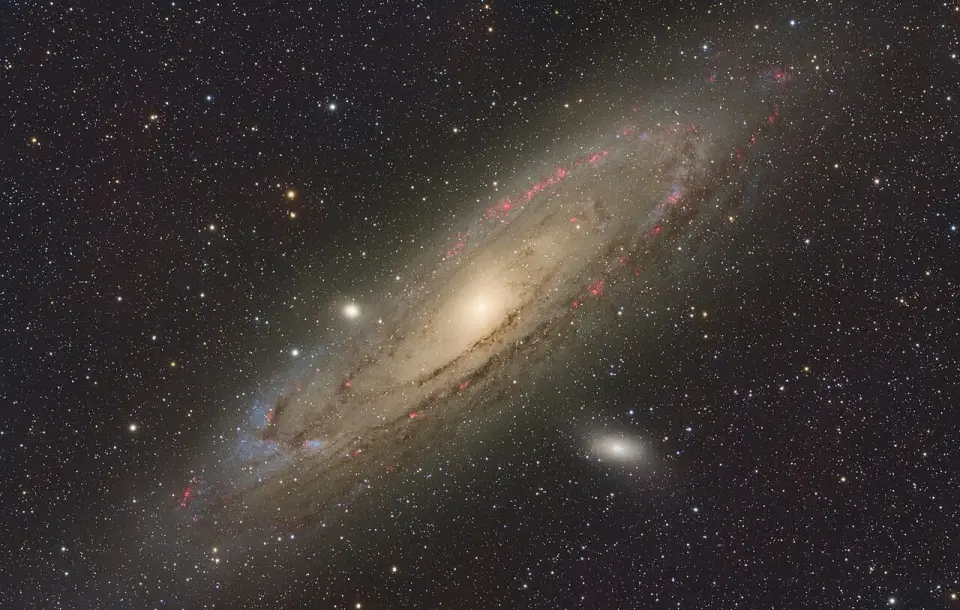
A new analysis of Hubble Space Telescope data reveals that the Andromeda Galaxy (M31) has significantly slowed its rate of star formation over the past 500 million years, with a sharp decline in the last 40 million years. Researchers mapped approximately 200 million stars across two-thirds of Andromeda’s disk, finding that current star formation is roughly one-fifth of a solar mass per year, down from one solar mass per year half a billion years ago. The slowdown is most pronounced on the side of Andromeda facing the compact satellite galaxy M32, which is suspected to have interacted with Andromeda’s disk. While the exact cause remains unproven, M32 is considered the leading suspect. Future observations by the Nancy Grace Roman Space Telescope are expected to provide a more complete picture of this galactic evolution.
Key points
- Hubble surveys PHAT and PHAST mapped about 200 million stars in Andromeda, covering two-thirds of its disk.
- Star formation in Andromeda has declined from 1 solar mass per year 500 million years ago to 0.2 solar masses per year today.
- The decline is most severe on the side of Andromeda closest to the satellite galaxy M32, which began about 60 million years ago.
- M32, a compact galaxy 16,000 light-years from Andromeda, is suspected to have influenced this slowdown, though proof is lacking.
- The Nancy Grace Roman Space Telescope, launching in late 2026, will image Andromeda’s entire disk to further study this phenomenon.
Background
Andromeda, located 2.5 million light-years away, is the nearest major galaxy to the Milky Way and serves as a critical analog for understanding our own galaxy’s evolution. Previous studies had noted a starburst in Andromeda about 2 billion years ago, likely due to a merger, followed by a gradual decline. This new study provides a detailed timeline of that decline, confirming that Andromeda is entering a quiescent phase. The galaxy is also expected to collide with the Milky Way in about 5 billion years, a future event that may be influenced by its current state.
How outlets are covering it
All four sources agree on the core findings: the decline in star formation, the role of Hubble data, and the suspicion that M32 is involved. ZME Science and Universe Today emphasize the detailed mapping of 200 million stars and the specific rates of decline. Space.com highlights the 'bullying' aspect of M32, while UA.NEWS provides a concise summary of the rate changes. The primary difference is in emphasis: ZME Science and Universe Today focus on the archival value of Hubble data and the upcoming Roman Telescope, whereas Space.com and UA.NEWS focus more on the M32 interaction as the primary driver of the slowdown. No source disputes the data, but they frame the narrative slightly differently, with some focusing on the natural winding down of the galaxy and others on the external influence of M32.
Why it matters
Understanding Andromeda’s star formation history helps astronomers model the evolution of spiral galaxies, including the Milky Way. The findings suggest that galaxies can enter quiescent phases due to internal processes or external interactions, which has implications for predicting the future of our own galaxy. The upcoming Roman Space Telescope will provide even more detailed data, potentially confirming or refuting the role of M32 in Andromeda’s decline.
What to watch
The Nancy Grace Roman Space Telescope is scheduled to launch in late 2026 and will image Andromeda’s entire disk, potentially adding hundreds of millions more stars to the catalog. This will allow astronomers to more precisely determine the cause of the star formation decline and test the hypothesis that M32 is responsible. Further ground-based observations will also be combined with Hubble data to refine the timeline of Andromeda’s evolution.
- The Milky Way’s Giant Neighbor, Andromeda, May Be Slowly Shutting Down New Stars ZME Science
- Hubble Reveals that Star Formation is Slowing Down in the Andromeda Galaxy Universe Today
- The Andromeda galaxy may be getting bullied by a smaller galactic neighbor, scientists find Space
- The rate of star formation in Andromeda has slowed sharply UA.NEWS
- What is happening with Andromeda? Scientists suspect the influence of a small neighboring galaxy Inbox.lv
Want the full story? Read the original reporting
Read on ZME Science