
SN 2026gzf: A Faint X-ray Flash Reveals a Missing Link in Supernova Physics
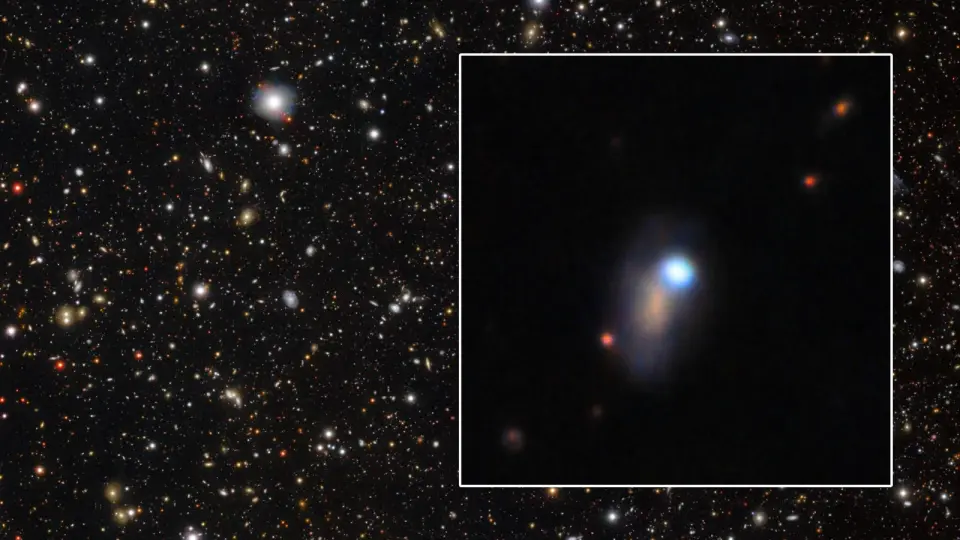
Astronomers captured the rare 'shock breakout' of supernova SN 2026gzf, a massive star that exploded without producing the expected gamma-ray burst or relativistic jets. Detected in March 2026 by China's Einstein Probe, the event offers the most detailed view yet of a broad-lined Type Ic supernova's early stages, suggesting massive stars can die through diverse pathways.
Key points
- China's Einstein Probe detected a brief X-ray flash from a galaxy 500 million light-years away in March 2026, identifying the source as supernova SN 2026gzf.
- The event is the second confirmed X-ray shock breakout observed in over 20 years, providing a rare glimpse of the initial moment a blast wave reaches a star's surface.
- SN 2026gzf is classified as a broad-lined Type Ic supernova, typically associated with powerful jets and gamma-ray bursts, but no such jets or afterglows were detected.
- The progenitor was identified as a Wolf-Rayet star, approximately 20 times the mass of the Sun, which had shed its outer hydrogen and helium layers before collapsing.
- A global network of telescopes, including the Dark Energy Camera and Vera C. Rubin Observatory, tracked the explosion's evolution, mapping the pre-explosion environment in unprecedented detail.
Background
This discovery builds on recent efforts to understand the diverse death pathways of massive stars. In July 2026, researchers reported on a rare double-supernova binary system, highlighting how massive stars evolve and explode. Additionally, observations of supernova SN 2024afav in the same month revealed the birth of a magnetar, another distinct outcome of stellar collapse. SN 2026gzf adds to this picture by demonstrating a scenario where a star that resembles gamma-ray burst progenitors fails to produce the expected high-energy jets.
How outlets are covering it
Space.com and Live Science emphasize the rarity of the observation, noting that shock breakouts are notoriously difficult to capture due to their short duration. PetaPixel highlights the 'exceptionally rare' nature of the event, being only the second confirmed X-ray shock breakout in two decades. Carnegie Mellon University focuses on the scientific implications, specifically the absence of relativistic jets, which challenges existing models of how similar stars typically die. While all sources agree on the classification of the supernova, they differ in emphasis: some focus on the technical achievement of the global observing campaign, while others focus on the theoretical puzzle of why this star did not produce a gamma-ray burst.
Why it matters
This event provides critical data for understanding the physics of stellar explosions. By observing a supernova that lacks the typical jets of a gamma-ray burst, scientists can test theories about why some massive stars produce these high-energy events while others do not. The detailed mapping of the pre-explosion environment, including shells of material ejected by the star, offers insights into the 'lifestyle' of massive stars before they collapse, potentially explaining the diversity of supernova outcomes.
What to watch
Researchers will continue to monitor SN 2026gzf using the Vera C. Rubin Observatory to track its long-term evolution. The data collected will help refine models of stellar death and may lead to the discovery of similar 'choked' jets in other supernovae. Future observations aim to determine if all stripped massive stars exhibit similar pre-explosion mass loss patterns.
- Astronomers witness the strange final moments of a massive star's supernova death (video) Space
- Astronomers catch massive star's death from the first explosive moment Phys.org
- A star 20 times the size of the sun died in a supernova — and telescopes around the world joined forces to watch it Live Science
- Astronomers Capture 'Exceptionally Rare' Star Explosion for Only the Second Time in 20 Years PetaPixel
- Rare Stellar Explosion Gives Astronomers a Front-Row Seat to a Massive Star’s Death Carnegie Mellon University
Want the full story? Read the original reporting
Read on Space