
Global Telescope Network Captures Rare, Jetless Supernova in Unprecedented Detail
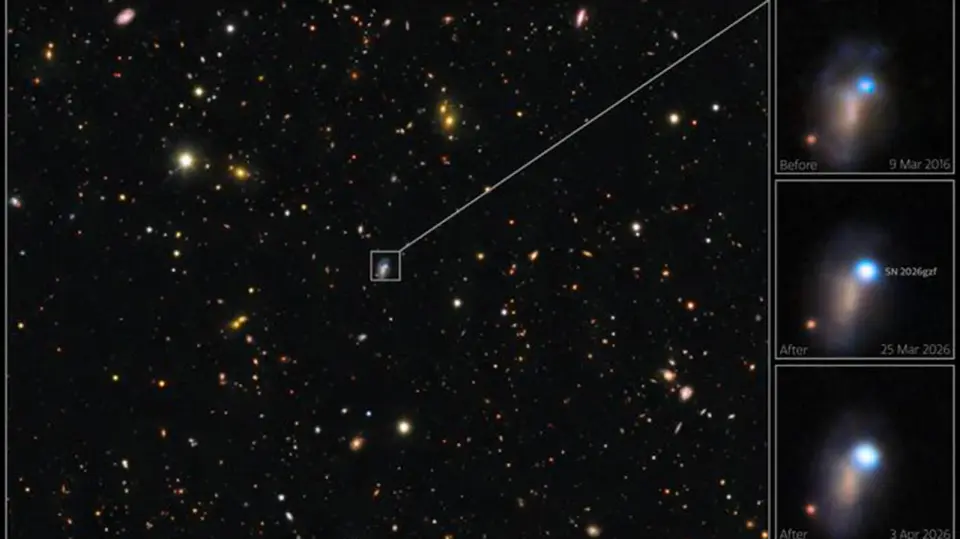
Astronomers have achieved a historic breakthrough by capturing the initial moments of a supernova explosion with unprecedented clarity. The event, designated SN 2026gzf, was first detected by China’s Einstein Probe space telescope in March 2026 as a faint X-ray flash. A rapid, coordinated response from a global network of observatories, including the newly operational Vera C. Rubin Observatory, allowed researchers to track the explosion from its 'shock breakout' through its evolution. This is only the second time in two decades that a shock wave has been observed in such detail. The supernova, located 500 million light-years away, is classified as a broad-lined Type Ic, a type typically associated with gamma-ray bursts. However, this event presented a surprise: it produced no gamma-ray burst and lacked the high-velocity jets usually seen in such explosions. Researchers suggest the jet may have been 'choked' by the star's surface or surrounding material. The findings, published in The Astrophysical Journal Letters, offer new insights into the diverse pathways of massive stellar death.
Key points
- China’s Einstein Probe space telescope detected the supernova’s X-ray shock breakout in March 2026, triggering a global observing campaign within one hour.
- The event, SN 2026gzf, is the second clear X-ray shock breakout observed in 20 years, a rare occurrence due to the brief duration of such events.
- The supernova is classified as a broad-lined Type Ic, a category often linked to gamma-ray bursts, but no gamma-ray burst or relativistic jet was detected.
- The Vera C. Rubin Observatory, which began its 10-year survey in late June 2026, was monitoring the region and provided critical long-term tracking data.
- Archival data from the Dark Energy Camera revealed a 'blue source' at the supernova’s location, offering clues about the star’s pre-explosion environment.
- The progenitor star was a Wolf-Rayet star, approximately 20 times the mass of the sun, which had shed most of its hydrogen and helium before collapsing.
Background
This discovery builds on recent advancements in time-domain astronomy, where multiple observatories collaborate to capture transient cosmic events. It follows the James Webb Space Telescope’s 2026 release of the largest 3D map of the universe, which enhanced our understanding of large-scale cosmic structures. Additionally, it complements ongoing efforts in neutrino astronomy, which aims to detect hidden galactic explosions that optical observations may miss. The ability to observe a supernova’s shock breakout in such detail is a significant step forward from previous limitations, where such events were rarely captured due to their short duration.
How outlets are covering it
Live Science emphasizes the unprecedented detail of the observations, highlighting the role of the Vera C. Rubin Observatory and the Dark Energy Camera in mapping the supernova’s evolution and pre-explosion environment. Space.com focuses on the 'strange final moments' of the star’s death, underscoring the rarity of the event and its implications for understanding stellar lifecycles. Carnegie Mellon University, which led the observing campaign, stresses the scientific significance of the absence of a gamma-ray burst, suggesting that massive stars can die through pathways not previously recognized. All sources agree on the event’s classification and the lack of a gamma-ray burst, but they differ in emphasis: Live Science and Space.com highlight the observational achievement, while Carnegie Mellon focuses on the theoretical implications for stellar evolution.
Why it matters
This event provides a rare opportunity to study the physics of supernova shock breakouts and the conditions that prevent the formation of gamma-ray bursts. It challenges existing models of stellar death and may lead to a better understanding of the diverse ways massive stars end their lives. The success of the global observing campaign also demonstrates the power of time-domain astronomy and the importance of rapid, coordinated responses to transient cosmic events. The data collected will be valuable for future research, as the Vera C. Rubin Observatory continues to monitor the supernova over the coming years.
What to watch
The Vera C. Rubin Observatory is expected to continue monitoring SN 2026gzf for years, providing detailed, long-term records of its evolution. Researchers will analyze the data to further understand the star’s pre-explosion environment and the mechanisms that led to the absence of a gamma-ray burst. The findings may inform future models of stellar evolution and the conditions that lead to different types of supernovae. Additionally, the success of this observing campaign may inspire similar collaborations for future transient events, enhancing our ability to capture fleeting cosmic phenomena in real time.
- A star 20 times the size of the sun died in a supernova — and telescopes around the world joined forces to watch it livescience.com
- Astronomers witness the strange final moments of a massive star's supernova death (video) Space
- Astronomers Catch Massive Star’s Death From the First Explosive Moment NOIRLab
- Astronomers catch massive star's death from the first explosive moment Phys.org
- Rare Stellar Explosion Gives Astronomers a Front-Row Seat to a Massive Star’s Death Carnegie Mellon University
Want the full story? Read the original reporting
Read on livescience.com