
Hubble reveals massive 'superbubble' void in Large Magellanic Cloud
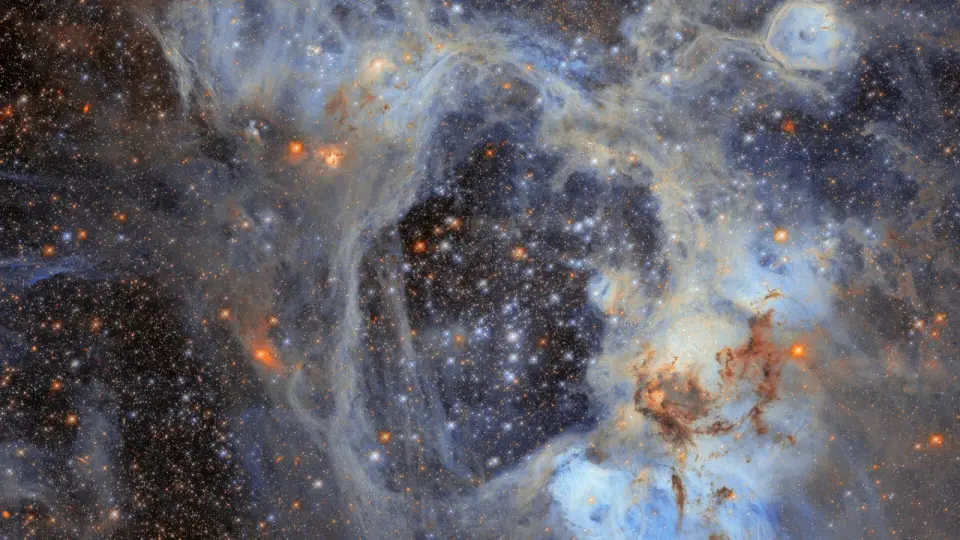
Hubble has captured a new image of the N44 nebula in the Large Magellanic Cloud, revealing a 210 by 140 light-year void known as a 'superbubble.' Created by stellar winds and supernovae, this cavity is surrounded by a dense gas shell where new stars are forming. The image supports a census of nearly 500,000 stars, including 30,000 pre-main-sequence stars, helping astronomers study the timeline of star formation in metal-poor regions.
Key points
- The Hubble Space Telescope has released a new image of the LHA 120-N44 nebula, located in the Large Magellanic Cloud (LMC) approximately 160,000 light-years from Earth.
- The image highlights a central void, or 'superbubble,' measuring roughly 210 by 140 light-years across, which was carved out by the intense stellar winds and supernovae of massive stars at the center.
- The expelled gas formed a dense, dusty shell around the void, which is now a site of active star formation, with new stars forming in the compressed gas.
- Hubble’s observations catalogued nearly 500,000 stars in the region, including 30,000 pre-main-sequence stars that have not yet begun fusing hydrogen, providing data on the duration of the star formation process.
- The nebula is an emission nebula, with its gas energized by ultraviolet radiation from massive stars, and features a smaller bubble known as N44F in the upper right, sculpted by the winds of a single hot star.
Background
This discovery follows recent Hubble observations of other celestial phenomena, such as the decagonal storm on Saturn’s south pole and the spiral galaxy M74. The LMC is a satellite galaxy of the Milky Way, often used as a laboratory for studying star formation in environments with lower metallicity than our own galaxy.
How outlets are covering it
Space.com and Silicon Republic emphasize the visual spectacle and the sheer scale of the superbubble, noting its dimensions relative to the solar system. The European Space Agency (ESA) provides the scientific context, detailing the specific observing program (#14689) led by D. Gouliermis and the census of pre-main-sequence stars. All sources agree on the mechanism of the void’s creation via stellar winds and supernovae, but ESA and Silicon Republic offer more detail on the ongoing research into the timescale of star formation and the specific features like N44F.
Why it matters
Understanding the formation and evolution of superbubbles in the LMC helps astronomers refine models of star formation in metal-poor environments, which are similar to conditions in the early universe. The high-resolution data from Hubble allows for a detailed census of young stars, providing crucial insights into the mass and age of newborn stars.
What to watch
Researchers will continue to analyze the Hubble data to determine the exact timescale of star formation, from the collapse of gas clouds to the ignition of nuclear fusion. Further studies may also explore the properties of the pre-main-sequence stars and the dynamics of the gas shell surrounding the superbubble.
- Hubble Telescope sees spectacular 'superbubble' photo of the day for Sept. 4, 2026 Space
- NASA’s Hubble pops in on a ‘superbubble’ Yahoo
- Photo: NASA's Hubble spies superbubble scene Phys.org
- Hubble's superbubble scene European Space Agency
- Hubble Space Telescope captures nebula ‘superbubble’ Silicon Republic
Want the full story? Read the original reporting
Read on Space