
JWST Identifies Record-Breaking Fast Radio Burst from a Tiny, Ancient Galaxy
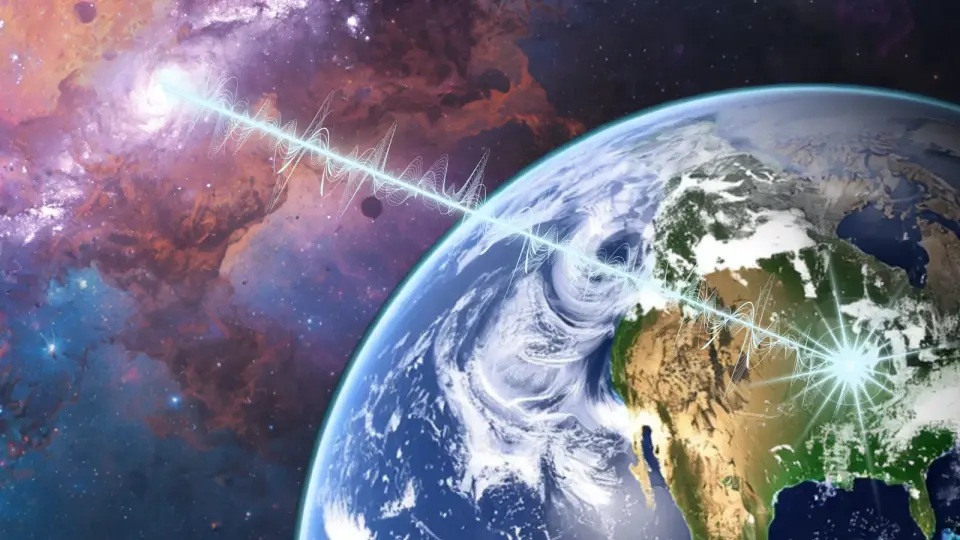
Astronomers have identified the most distant fast radio burst (FRB) ever detected, designated FRB 20240304B. Discovered by the MeerKAT telescope in South Africa in March 2024, the signal traveled for over 10 billion years, originating when the universe was just 3 billion years old. The James Webb Space Telescope (JWST) pinpointed its host as a surprisingly small, metal-poor dwarf galaxy actively forming stars, a finding that challenges existing theories about FRB origins and offers new data for mapping the cosmic web.
Key points
- FRB 20240304B is the most distant fast radio burst ever recorded, more than doubling the previous distance record.
- The burst was first detected by the MeerKAT radio telescope in South Africa and subsequently localized using the James Webb Space Telescope.
- JWST’s NIRCam and NIRSpec instruments confirmed the host galaxy’s redshift at 2.148, placing its origin approximately 3 billion years after the Big Bang.
- The host galaxy is unexpectedly small, metal-poor, and undergoing rapid star formation, contrary to expectations that FRBs originate in massive, evolved galaxies.
- The discovery suggests that FRBs may be common in the early universe and provides a method to map the distribution of matter in the intergalactic medium.
Background
Fast radio bursts (FRBs) are mysterious, millisecond-long flashes of radio energy that have puzzled scientists since their discovery in 2007. While previous studies have used FRBs to estimate the distribution of ordinary matter in the universe, this new detection pushes the boundaries of cosmic history. The finding aligns with recent JWST discoveries of water and oxygen-rich dust near the Milky Way’s black hole, highlighting the telescope’s role in probing extreme and distant environments. This event also follows earlier archive coverage of record-breaking radio bursts, reinforcing the growing capability to detect signals from the early universe.
How outlets are covering it
Space.com and NASA emphasize the surprise factor of the host galaxy’s small size and metal-poor nature, which challenges the theory that FRBs result from neutron star mergers (which require older, evolved stellar populations). The Guardian highlights the burst’s journey through 80% of cosmic history and notes that while the source remains uncertain, the event validates FRBs as tools for probing the universe. ABC News focuses on the human perspective, noting that the Sun and Earth did not exist when the burst was emitted, and discusses the potential for FRBs to map the cosmic web. All sources agree that the discovery is a significant milestone for understanding the early universe and the nature of FRBs.
Why it matters
This discovery provides a new benchmark for the distance and age of fast radio bursts, offering critical insights into the conditions of the early universe. By identifying a small, metal-poor galaxy as the host, scientists can refine theories about the mechanisms that generate FRBs, potentially favoring magnetars over neutron star mergers. Additionally, the burst’s signal carries imprints of the intergalactic medium, allowing astronomers to map the distribution of matter across billions of light-years, which is essential for understanding the evolution of the cosmic web.
What to watch
The research team plans to use the MeerKAT telescope to detect and localize several more distant FRBs per year, with the James Webb Space Telescope playing a crucial role in characterizing their host galaxies. As new radio telescope facilities come online, the discovery pace is expected to increase, providing more data on the distribution of matter in the universe and the origins of fast radio bursts.
- James Webb Space Telescope helps detect the most distant Fast Radio Burst ever seen — and scientists are surprised by its source Space
- Astronomers detect mysterious burst of energy from a galaxy far, far away The Guardian
- It took 10 billion years for this signal from the early universe to reach us ABC News & Headlines – Australian Broadcasting Corporation
- Webb Measures Distance to Farthest Fast Radio Burst, Suggesting Origin NASA Science (.gov)
- Astronomers pinpoint the most distant fast radio burst ever detected Phys.org
Want the full story? Read the original reporting
Read on Space