
Cohesin loop extrusion drives replication fork reversal to maintain genome stability under stress
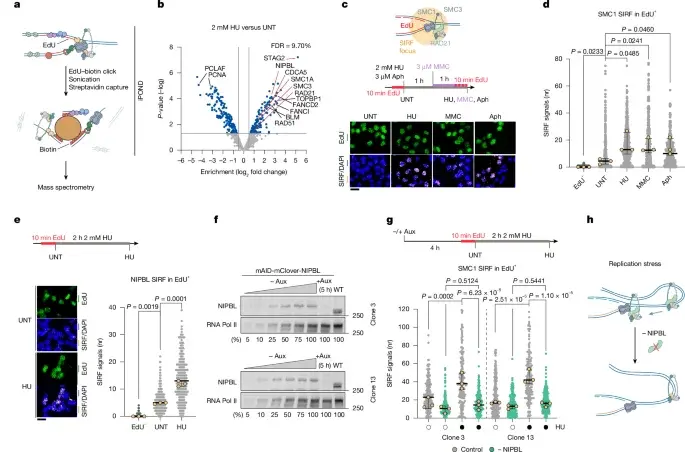
A new study in Nature reveals that the cohesin complex actively reshapes DNA replication forks under stress. By using loop extrusion, cohesin limits sister-fork coupling and promotes inter-replicon contacts, which facilitates fork slowing and reversal. This mechanism prevents the primase PRIMPOL from causing discontinuous DNA synthesis, thereby ensuring genome stability. The findings suggest that cohesin mutations in tumors could impact cancer therapy efficacy.
Key points
- Cohesin accumulates at stalled replication forks in a manner dependent on the chromatin loader NIPBL, not on cohesion establishment or WAPL unloading.
- Researchers developed a new technique called Repli-C to map chromatin contacts at nascent DNA, revealing that cohesin restricts 'fountain-like' structures at replication origins.
- Under replication stress, cohesin promotes contacts between forks of neighboring replicons, a process that is dependent on loop extrusion activity.
- Loop-extruding cohesin promotes fork slowing and reversal by preventing the action of PRIMPOL, which otherwise leads to unrestrained and discontinuous DNA synthesis.
- The study highlights that the replication stress response is topologically integrated across the genome, with potential implications for cancer therapies targeting cohesin mutations.
Background
Previous research established that cohesin organizes the genome into topologically associating domains (TADs) and regulates replication origin positioning. While transient sister-fork interactions were observed during unperturbed replication, the functional role of cohesin in replication stress response remained unknown. Earlier studies also noted that cohesin accumulates at stalled forks, but the specific mechanism and its impact on fork plasticity were not fully understood.
How outlets are covering it
The primary source, Nature, provides a comprehensive molecular analysis of cohesin's role in replication stress, detailing the use of auxin-inducible degrons, separation-of-function mutants, and the new Repli-C technique. The secondary source, Demócrata, is inaccessible due to a 403 error and provides no information. Therefore, no comparative perspectives from multiple outlets are available, and the briefing relies solely on the detailed findings from the Nature article.
Why it matters
Understanding how cohesin regulates replication forks under stress is crucial for developing cancer therapies. Since cohesin mutations are frequent in tumors, targeting this mechanism could improve the efficacy of chemotherapeutic treatments that induce replication stress. The study provides a new perspective on genome stability and the topological integration of the replication stress response.
What to watch
Future research may focus on how cohesin mutations in tumors affect replication stress response and cancer therapy outcomes. Additionally, further studies could explore the clinical implications of targeting cohesin-mediated fork reversal in cancer treatment.
Want the full story? Read the original reporting
Read on Nature