
Arctic Sea Ice Hits 2026 Minimum, Tying Decade-Old Low
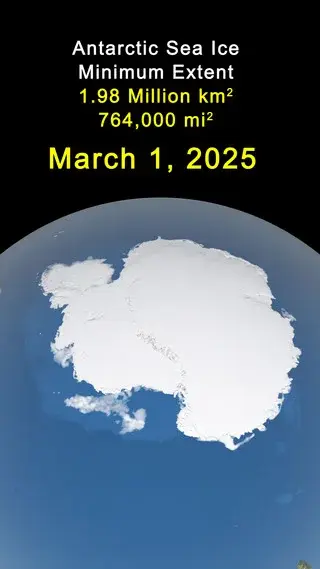
Arctic sea ice reached its annual minimum extent on September 12, 2026, covering 4.6 million square kilometers. This figure ties 2008, 2010, and 2025 for the 10th-lowest recorded minimum since satellite observations began in 1978. While the extent has plateaued in recent years due to increased cloud cover, it remains significantly lower than historical averages, with the last 20 years accounting for the 20 lowest minimums on record.
Key points
- The 2026 minimum extent of 4.6 million square kilometers was confirmed by NASA and the National Snow and Ice Data Center (NSIDC).
- This level ties for the 10th-lowest minimum in the nearly 48-year satellite record, alongside 2008, 2010, and 2025.
- The 20 lowest annual minimums in the satellite record have all occurred between 2007 and 2026.
- Recent stability in ice extent is attributed to increased cloud cover blocking solar radiation, though levels remain far below early 1980s averages.
- Antarctic sea ice experienced an unusual 116,000-square-mile drop in August before resuming seasonal growth, likely due to weather-driven compaction.
Background
Recent months have seen significant Arctic ice activity, including a massive calving event from Greenland’s Petermann Glacier in August 2026 and open water appearing just 37 miles from the North Pole in late August. These events highlight the ongoing fragility of Arctic ice, even as the annual minimum extent has shown a temporary plateau in recent years.
How outlets are covering it
NASA and NSIDC emphasize the long-term decline, noting that the 2026 minimum is nearly 15% lower than any pre-2007 year. Rick Thoman of the Alaska and Arctic Climate Newsletter highlights regional variations, noting that Asian Arctic seas have seen some recovery in ice extent, while Pacific Arctic seas remain flat. India Today contextualizes the global impact, explaining how reduced ice cover increases heat absorption and affects atmospheric circulation, potentially influencing weather patterns in South Asia, though it cautions against direct causal links to specific local events.
Why it matters
The 2026 minimum underscores the persistent long-term decline in Arctic sea ice, despite recent year-to-year stability. This trend has significant implications for global climate systems, sea levels, and international shipping routes, as the Arctic becomes increasingly navigable and ecologically vulnerable.
What to watch
Scientists will monitor the Antarctic sea ice maximum, expected in late September or early October. Continued satellite observations will track whether the 2026 Arctic minimum remains stable or if late-season weather causes further melt. Long-term trends will be assessed as new data from the AMSR2 instrument and other satellites are integrated into the record.
- Arctic Sea Ice Reaches 2026 Annual Minimum Extent NASA Science (.gov)
- Satellite record reveals Arctic melt season has plateaued after decades of lengthening Phys.org
- Arctic sea ice: a more complex story than forecasts High North News
- Nasa satellites captures Arctic sea ice shrinking as Earth's white crown melts climate change global warming India Today
- Arctic 2026 Sea Ice Minimum Alaska and Arctic Climate Newsletter
Want the full story? Read the original reporting
Read on NASA Science (.gov)