
Gravitational Wave Astronomy Matures Into a Fully-Fledged Science
TL;DR
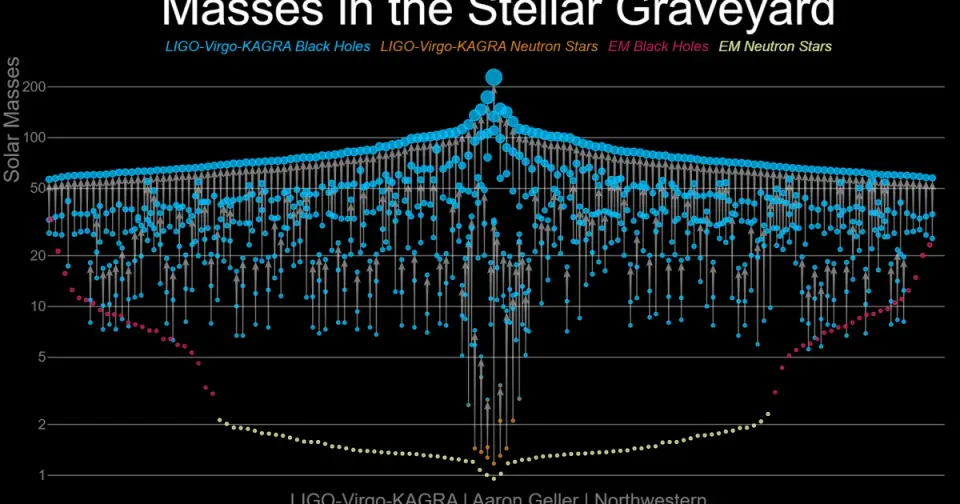
Gravitational wave astronomy has matured from a rare detection to a fully developed science: by mid-2026 there are 390 confirmed events across four detectors (LIGO, Virgo, KAGRA), boosted by upgrades and the addition of LIGO India (beginning around 2030) with space-based prospects like LISA on the horizon. The growing catalog enables population studies of stellar-mass black holes and neutron stars, improved sky localization, and stringent tests of general relativity, signaling a collaborative, high-impact future for gravitational wave science.
Topics:sciencescience-and-tech#astronomy#black-holes#gravitational-waves#ligo-virgo-kagra#neutron-stars#science-and-tech
- Gravitational wave astronomy is now a fully mature science Big Think
- Astronomers discover a 'lost world' of black hole mergers: 'It's the astronomical equivalent of uncovering an ancient civilization' Space
- Scientists Stunned: Two Black Holes Captured Together in a Historic First Futura, le média qui explore le monde
- The Universe Is Full of ‘Impossible’ Black Holes. Scientists Now Know Why WIRED
- The ‘age of gravitational astronomy’ is here Scientific American
Want the full story? Read the original reporting
Read on Big Think