
Simulations suggest SpaceX's proposed million-satellite AI network could outshine natural stars
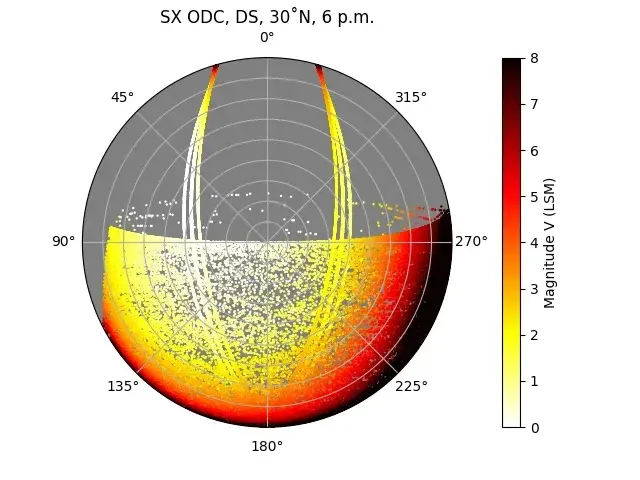
A new preprint models the visual impact of SpaceX's proposed one-million-satellite AI data-center network, finding that the fleet could outshine natural stars for large portions of the night and year. The study highlights that the massive scale and reflectivity of the proposed spacecraft would create dense, bright arcs in the sky, potentially overwhelming astronomical observations and naked-eye visibility. While the proposal is currently an application ceiling rather than an approved fleet, the findings underscore the need for regulatory oversight and brightness mitigation to prevent the artificial sky from becoming the majority.
Key points
- SpaceX applied to the FCC in January 2026 for up to one million orbital data-center satellites, a figure accepted for filing but not yet authorized for launch.
- A preprint by Aaron Boley, Samantha Lawler, and Hanno Rein simulates the visual impact of this fleet, finding that at worst, 79,000 satellites could be visible to the naked eye, outnumbering the roughly 500 natural stars brighter than magnitude 5.
- The proposed satellites are enormous, with a cross-sectional area of about 800 square meters, and are designed to operate in sun-synchronous orbits that create dense, bright arcs near the terminator.
- The study emphasizes that the fleet is an application ceiling, not a launch schedule, and that the FCC has not yet authorized the full scale or certified the architecture as safe.
- The findings highlight the need for regulatory oversight and brightness mitigation to prevent the artificial sky from becoming the majority and to protect astronomical observations.
Background
This story builds on earlier coverage of SpaceX's growing dominance in low Earth orbit, with Starlink accounting for about two-thirds of all active spacecraft as of August 2026. It also follows concerns about other large-scale orbital projects, such as Reflect Orbital's space mirrors, which could brighten the night sky and hinder astronomy. The current debate over SpaceX's AI data-center network adds to a broader discussion about the environmental and astronomical impacts of massive satellite constellations.
How outlets are covering it
Space Daily and the preprint authors emphasize the visual and astronomical impact of the proposed fleet, highlighting the need for regulatory oversight and brightness mitigation. Morgan Lewis focuses on the legal and regulatory implications, arguing that the FCC must determine whether NEPA applies to space-based operations and how to assess the environmental effects of such large-scale infrastructure. ExtremeTech and the European Southern Observatory warn that the proposed increase in satellites could be catastrophic for astronomy, with the potential to block views of even orbital telescopes. The perspectives differ in their emphasis, with some focusing on the visual impact and others on the legal and regulatory challenges, but all agree that the scale of the proposed fleet is unprecedented and requires careful consideration.
Why it matters
The proposed one-million-satellite AI data-center network could fundamentally change the night sky, potentially outshining natural stars and hindering astronomical observations. The findings underscore the need for regulatory oversight and brightness mitigation to prevent the artificial sky from becoming the majority and to protect the environment and scientific research. The debate also highlights the tension between commercial space expansion and the preservation of dark skies for astronomy.
What to watch
The FCC will continue to review SpaceX's application for the one-million-satellite network, and the outcome of this review could have significant implications for the future of orbital infrastructure. The preprint authors and other stakeholders will likely advocate for firm limits, brightness commitments, and regulatory oversight to ensure that the proposed fleet does not overwhelm the natural sky. The legal and regulatory challenges surrounding NEPA and the environmental effects of space-based operations will also be closely watched, as they could set precedents for future large-scale orbital projects.
- In 2026, astronomer Samantha Lawler and two colleagues modelled SpaceX’s proposal for one million orbital AI data-centre satellites and found that, if they are launched with the assumed sizes and reflectivity, naked-eye satellites could outnumber visible star Space Daily
- Elon Musk's orbital AI network could send a new kind of e-waste beyond Earth's reach Yahoo
- Orbital Data Centers Could Put National Environmental Policy Act to the Test in Space Morgan Lewis
- Astronomy or Megaconstellations: New Study Shows We Can't Have Both extremetech.com
- 1.7 Million Satellites Could Threaten Astronomy ColombiaOne.com
Want the full story? Read the original reporting
Read on Space Daily