
New 'Encapsulation Epitaxy' Method Enables Air-Stable 2D Superconductors for Quantum Circuits
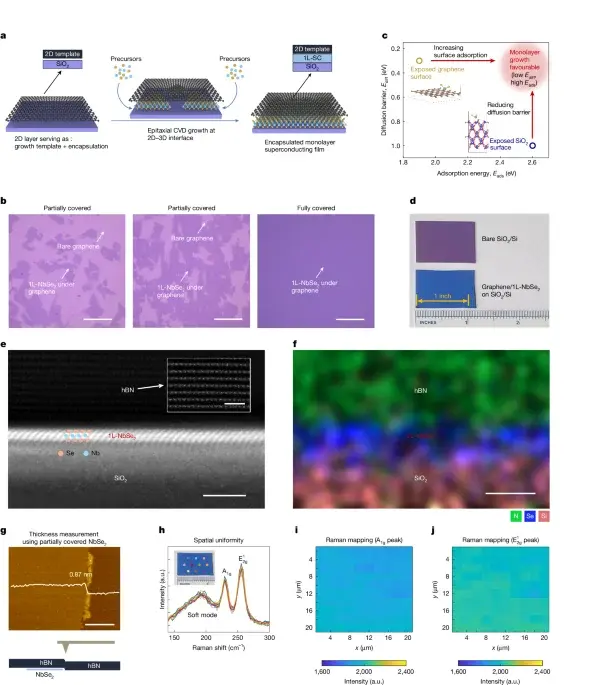
Researchers have developed a new growth technique called 'encapsulation epitaxy' to produce large-area, air-stable monolayer niobium diselenide (NbSe2) films. This method solves the oxidation problem of 2D superconductors, enabling their integration into quantum circuits with high kinetic inductance.
Key points
- A new 'encapsulation epitaxy' mechanism allows the growth of large-area (over 1 inch) monolayer NbSe2 films that remain stable in air.
- The technique uses a 2D layer like graphene or hexagonal boron nitride as both a growth template and a protective cap against oxidation.
- The resulting NbSe2 films exhibit a superconducting transition temperature of approximately 1 K and a charge density wave transition temperature of 177 K.
- The material has a measured kinetic inductance of 0.7 nH per square, making it suitable for high-inductance quantum circuit elements.
- The method enables oxidation-free transfer and edge-contact techniques, facilitating the monolithic fabrication of superconducting quantum circuits.
Background
This development builds on the 2025 Nobel Prize in Physics, which recognized the 1984-85 discovery of macroscopic quantum tunnelling in superconducting circuits. The new 2D superconductor technology aims to miniaturize these circuits further using atomically thin materials.
Why it matters
This breakthrough addresses a major bottleneck in quantum computing: the fragility of 2D superconductors in ambient conditions. By enabling air-stable, wafer-scale production, it paves the way for more compact, scalable, and manufacturable superconducting quantum circuits.
What to watch
Researchers will likely focus on scaling this encapsulation epitaxy method to larger wafers and integrating the 2D NbSe2 into more complex, multi-component quantum circuits to test their performance in real-world applications.
Want the full story? Read the original reporting
Read on Nature