
JAXA Launches Historic Mission to Return First Samples from Mars' Moon Phobos
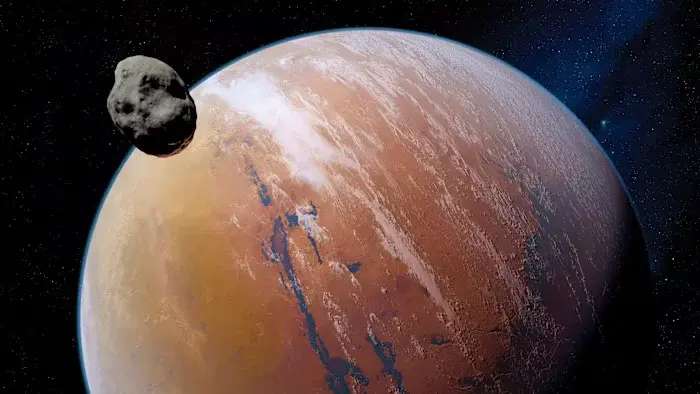
Japan's JAXA launched the Martian Moons Exploration (MMX) mission on October 19, 2026, from Tanegashima Space Center. This mission aims to be the first to retrieve physical samples from Mars' moon, Phobos, and return them to Earth by 2031. The spacecraft will land on Phobos no earlier than December 2028, collect approximately 10 grams of dust, and land the sample capsule in Australia. The primary goal is to determine the origin of Mars' moons, testing theories of giant impact versus captured asteroids.
Key points
- Launch occurred on October 19, 2026, at 04:41 local time from Tanegashima, Japan.
- The mission is led by JAXA with partners including NASA, ESA, and Honeybee Robotics.
- The spacecraft will arrive at Mars in August 2027 and land on Phobos no earlier than December 2028.
- A sample capsule containing at least 10 grams of Phobos soil is scheduled to return to Earth in 2031.
- The sample capsule will land in the Woomera desert in South Australia.
- NASA provided the Megane instrument and one sampler, with an estimated investment of $87 million over 14 years.
Background
Previous sample return missions, such as JAXA's Hayabusa and NASA's OSIRIS-REx, successfully retrieved material from asteroids. However, no mission has previously returned samples from a moon other than Earth's. The Nasa/ESA Mars Sample Return mission was effectively cancelled due to funding cuts by the US Congress, making this JAXA-led effort the primary near-term attempt to bring extraterrestrial material from the Mars system back to Earth for laboratory analysis.
How outlets are covering it
BBC and Mashable both emphasize the historic nature of the mission as the first to return samples from the Mars system. BBC highlights the scientific mystery of moon formation, while Mashable focuses on the technical challenges and international partnerships, noting NASA's financial contribution. The Financial Times headline indicates the story was behind a paywall, limiting its direct public commentary, but the secondary sources confirm the consensus on the mission's timeline and objectives. All sources agree on the launch date and the critical role of the sample in resolving the origin of Phobos and Deimos.
Why it matters
This mission represents a significant milestone in planetary science by providing the first direct physical samples from a Martian moon. The analysis of these samples could definitively determine the origin of Mars' moons, offering insights into the early solar system and the formation of terrestrial planets. Additionally, the success of this sample return could pave the way for future robotic and potentially human missions to Mars by demonstrating the feasibility of round-trip logistics to the Martian system.
What to watch
The spacecraft is expected to arrive at Mars in August 2027. It will survey Phobos and Deimos before attempting a landing on Phobos no earlier than December 2028. After collecting the sample, the return module will depart for Earth, with the capsule scheduled to land in Australia in 2031. Scientists will then analyze the 10-gram sample to determine its chemical and mineral composition, aiming to resolve the debate between the giant impact and captured asteroid theories.
- Japan leads mission to make first return trip to Mars Financial Times
- A Japanese Spacecraft Aims to Bring Back a Bit of a Martian Moon The New York Times
- Mission set to blast off for Mars to grab a piece of its moon BBC
- JAXA's Martian Moons Exploration mission launch: how to watch live Mashable
- Returning the first samples from a Martian moon: Inside the science of Japan's bold MMX mission to Mars Space
Want the full story? Read the original reporting
Read on Financial Times