
ProteinGuide enables on-the-fly conditioning of diverse AI models for protein engineering
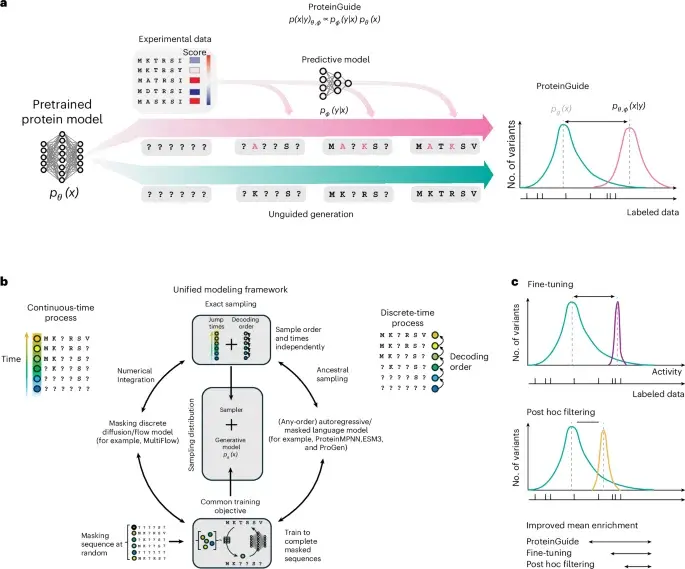
Researchers introduced ProteinGuide, a method that allows existing protein sequence generative models to be conditioned on experimental data without retraining. This framework unifies masked language models, autoregressive models, and diffusion models, enabling the design of proteins with specific properties like stability or activity. In a key application, ProteinGuide was used to improve the editing efficiency of an adenine base editor in vivo, outperforming results from seven rounds of traditional directed evolution.
Key points
- ProteinGuide provides a statistical framework for 'on-the-fly' conditioning of protein generative models using auxiliary information, eliminating the need for additional model training.
- The method is compatible with a broad class of models, including masked language models (e.g., ESM3), autoregressive models (e.g., ProteinMPNN), and discrete diffusion/flow-matching models (e.g., MultiFlow).
- Proof-of-concept experiments demonstrated the ability to design proteins with user-specified properties, such as higher stability or activity, and to optimize for two conflicting properties simultaneously.
- ProteinGuide was applied to wet-lab data generation to enhance the activity of an adenine base editor in vivo, achieving higher editing efficiency than previous directed evolution efforts.
- Code and data for the experiments are publicly available via GitHub, Zenodo, and the National Center for Biotechnology Information to facilitate further research.
Background
This development builds on recent advancements in AI-driven protein design, such as the Raygun framework, which uses autoencoders for rapid, length-agnostic protein redesign while preserving function. It also aligns with broader trends in using generative models for biological engineering, where efficiency and precision are critical. The ability to condition models without retraining addresses a significant bottleneck in applying AI to complex biological tasks, potentially accelerating the development of therapeutic tools like base editors.
Why it matters
ProteinGuide democratizes the use of advanced generative models for protein engineering by removing the need for costly and time-consuming retraining. This could significantly accelerate the development of new therapeutics, such as more efficient base editors, and enable researchers to explore complex, multi-property optimization tasks that were previously impractical. The open availability of code and data further promotes reproducibility and collaboration in the field.
What to watch
Researchers may explore the application of ProteinGuide to other biological systems and properties, such as enzyme activity or antibody design. The integration of wet-lab data with generative models could lead to new paradigms in directed evolution, potentially reducing the time and cost of developing new biological tools. Additionally, the framework may be adapted for other types of generative models or applied to non-protein biological sequences.
Want the full story? Read the original reporting
Read on Nature