
AI system XunZi identifies new Parkinson's drug targets
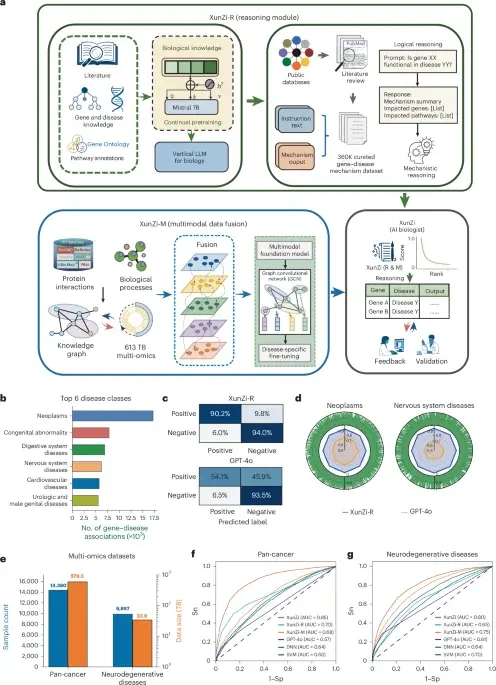
A new AI system named XunZi has been developed to autonomously generate testable hypotheses for disease-modifying therapeutic targets. Trained on massive datasets of biomedical literature and multi-omics data, the tool identifies potential drug targets by integrating logical reasoning with multimodal data fusion. In a key validation, XunZi identified the kinases CHK2 and IRAK4 as aberrantly activated in Parkinson's disease. Experimental tests confirmed that inhibiting CHK2 could rescue dopaminergic neuron loss and motor deficits in mouse models, demonstrating the system's potential to accelerate drug discovery.
Key points
- XunZi is an AI biologist designed to overcome human cognitive limits in synthesizing fragmented biomedical knowledge and multimodal data sources.
- The system was trained on 24.4 million publications and 613.6 TB of data covering 21,008 human genes and 5,850 diseases.
- XunZi outperforms existing methods in accuracy and interpretability across diverse disease contexts, including non-small-cell lung cancer.
- In Parkinson's disease, XunZi identified aberrant activation of CHK2 and IRAK4 kinases across multiple models.
- Pharmacological or genetic inhibition of Chk2 was shown to rescue dopaminergic neuron loss and motor deficits in Parkinson's disease mice.
- The source code for XunZi and other custom code have been uploaded to GitHub for public access.
Background
This development follows a trend in 2026 of using AI and repurposed drugs to find new therapeutic targets for neurodegenerative diseases. Earlier this year, research explored low-dose lithium as a potential disease-modifying therapy for Alzheimer's, and another study identified the Arc protein as a new target for slowing Alzheimer's progression by preventing toxic Tau spread between neurons. XunZi represents a more automated, data-driven approach to finding such targets across a wide range of diseases.
Why it matters
XunZi offers a new, potentially faster and more accurate method for identifying drug targets, which could significantly accelerate the development of therapies for complex diseases like Parkinson's that currently have limited treatment options. By automating the hypothesis generation process, it could help overcome the bottleneck of human cognitive limitations in processing vast amounts of biomedical data.
What to watch
The next steps will likely involve further validation of the targets identified by XunZi in human clinical trials and the application of the system to other diseases. The public availability of the source code on GitHub suggests that other research groups may begin to use and build upon XunZi for their own drug discovery efforts.
Want the full story? Read the original reporting
Read on nature.com