
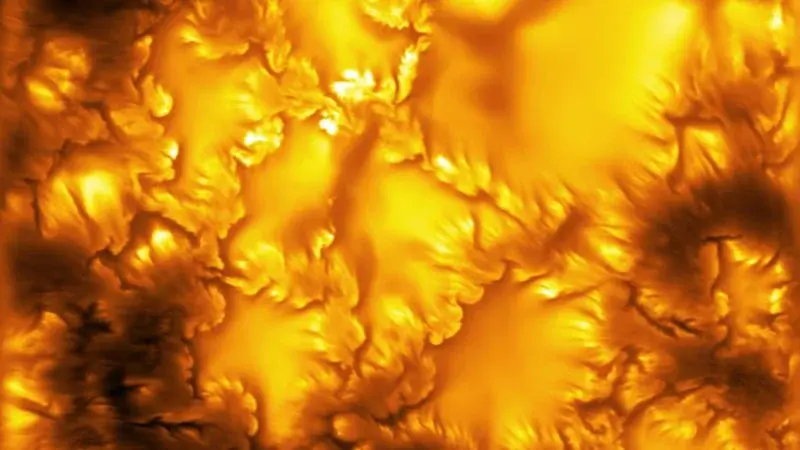
Sun’s surface whirlpools revealed by ultra-high-resolution telescope
TL;DR
Using the Daniel K. Inouye Solar Telescope near Maui, scientists captured the Sun’s visible surface in unprecedented detail, revealing Kelvin-Helmholtz instabilities—tiny swirling vortices along magnetic boundaries—that could explain why the Sun’s outer atmosphere (the corona) is hotter than its surface and how magnetic energy is built, released and transported to drive solar flares and coronal mass ejections. The observations align with advanced simulations and may improve space-weather forecasting that affects satellites and power grids.
Topics:sciencescience-space#coronal-heating#inouye-solar-telescope#kelvin-helmholtz-instability#science-space#solar-physics#sun
- Unprecedented images reveal hidden process driving solar activity CNN
- Ubiquitous Kelvin–Helmholtz instabilities driving plasma mixing on the Sun Nature
- NSF Inouye Solar Telescope Enables Major Discovery of a Hidden Solar Process NSO - National Solar Observatory
- Unprecedented images may explain one of greatest mysteries of the sun The Guardian
- See the Sun like never before with most detailed images yet BBC
Want the full story? Read the original reporting
Read on CNN