
Bianfu Cave Fossils Reveal 100,000-Year Denisovan History in China
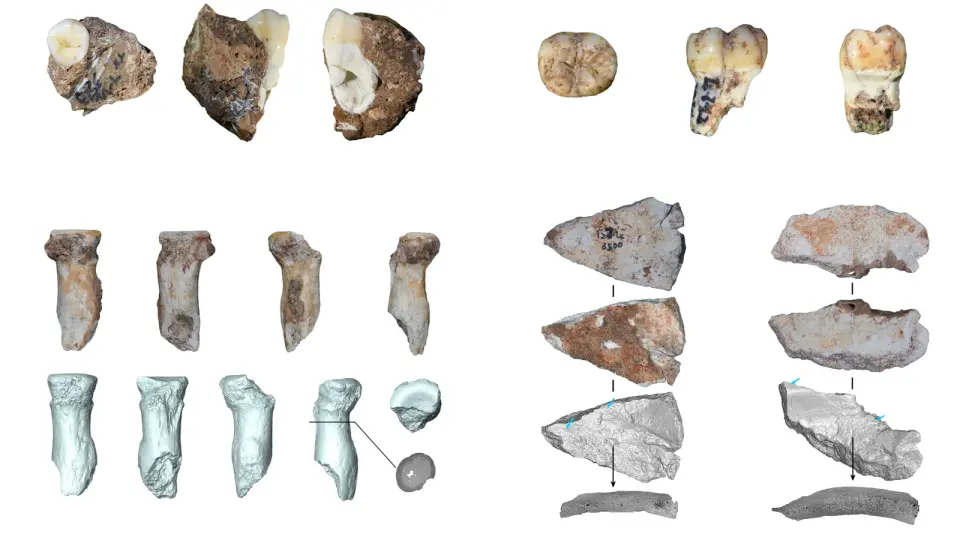
New findings from Bianfu Cave in Yunnan, China, confirm Denisovans lived in the region for over 100,000 years. Researchers identified five fossils, including the first-ever Denisovan arm bone, alongside thousands of stone tools and animal bones. The discovery provides the first direct link between Denisovan remains and their cultural artifacts, revealing their hunting strategies and lifestyle in a forested environment.
Key points
- Researchers identified five Denisovan fossils at Bianfu Cave in Yunnan, including four teeth, two skull fragments, and the first known Denisovan radius (arm bone).
- The fossils date to 134,000–167,000 years ago, while associated stone tools and animal bones indicate continuous occupation from 190,000 to 70,000 years ago.
- Identification relied on proteomic analysis of collagen and amino acid variations, as DNA was too degraded to extract from the 100,000-year-old remains.
- The site reveals Denisovans hunted large game like buffalo and deer in a conifer-dominated forest, using expedient stone tools and unmodified bones rather than sophisticated manufacturing.
- This is the first site in southern China to directly associate Denisovan fossils with rich cultural remains, expanding the known geographic range of the species beyond Siberia and the Tibetan Plateau.
Background
Denisovans are an extinct human lineage known primarily from fragmentary fossils and DNA, with previous finds limited to Siberia, the Tibetan Plateau, and a skull from northeastern China. Recent archive coverage noted that while DNA confirmed Denisovan ancestry in modern Southeast Asian and Oceanian populations, physical evidence of their daily lives was scarce. The 2025 discovery of the 'Dragon Man' skull provided a face for the species, but Bianfu Cave offers the first comprehensive record of their subsistence strategies and tool use in a single location.
How outlets are covering it
Live Science and National Geographic emphasize the rarity of the finds, particularly the first Denisovan arm bone and the direct link between fossils and tools. CNN highlights the 'expedient' nature of the tools, suggesting Denisovans were less invested in complex manufacturing than modern humans. The Nature study authors focus on the environmental context, noting a conifer forest habitat and specialized hunting of large prey. While all sources agree on the Denisovan identification via protein analysis, National Geographic notes that the thick skull fragments resemble Homo erectus and Neanderthals more than modern humans, whereas Live Science focuses on the broader implication for understanding Denisovan biology and culture in Asia.
Why it matters
This discovery fills a critical gap in understanding human evolution by providing the first direct evidence of Denisovan behavior, technology, and ecology in southern China. It confirms that Denisovans inhabited diverse environments, from Siberian mountains to subtropical forests, and offers insights into how they may have been outcompeted by Homo sapiens. The findings also reinforce the genetic legacy of Denisovans in modern populations across Southeast Asia and Oceania, bridging the gap between ancient DNA and physical archaeological evidence.
What to watch
Researchers plan to test sediment from the cave floor for hominin DNA to further confirm the exclusive Denisovan occupation of the site. Continued excavation and analysis of the 60,000+ animal bone fragments may yield more information about Denisovan diet and hunting strategies. Future studies may also compare the Bianfu Cave tools with other East Asian sites to determine if the 'expedient' technology was a widespread Denisovan trait or specific to this region.
- Enigmatic Denisovans lived by cave in what is now China for 100,000 years, rare fossils and handcrafted tools reveal Live Science
- Denisovans from southwestern China and their subsistence strategies Nature
- Researchers Discover Rare Denisovan Bones in a Cave in China National Geographic
- Fossil remains unearthed in China offer new clues about how Denisovans lived CNN
- Scientists unlock new clues to what Denisovans, a mysterious ancient human ancestor, looked like Scientific American
Want the full story? Read the original reporting
Read on Live Science