
NASA Orbiter Identifies Largest Modern Lunar Crater, Named McGetchin
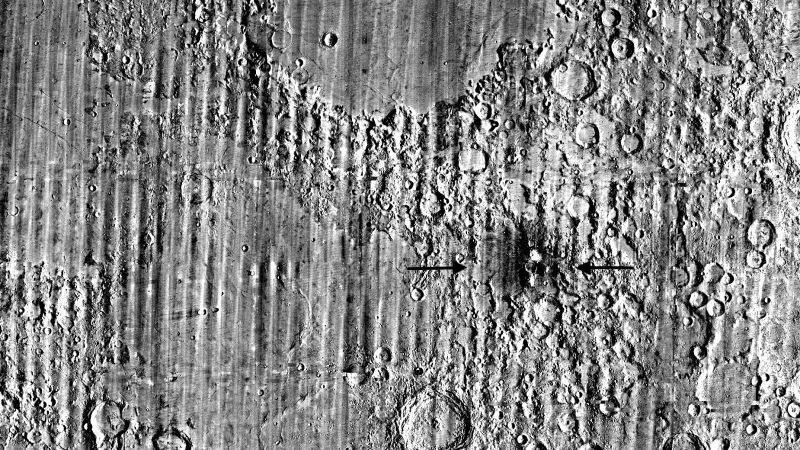
NASA’s Lunar Reconnaissance Orbiter (LRO) has identified the largest newly formed crater in the solar system, named McGetchin. Measuring 728 feet wide and 141 feet deep, the feature was created by an impact between April and May 2024. Discovered in October 2025, it represents a statistically rare event occurring roughly once every 132 years, highlighting the ongoing hazard of space debris for future lunar missions.
Key points
- The McGetchin crater, located on the Moon’s eastern edge, measures 728 feet (222 meters) in diameter and 141 feet (43 meters) in depth.
- The impact occurred between April 11 and May 22, 2024, but was not detected until October 24, 2025, when scientist Robert Wagner spotted an anomaly in LRO data.
- The impactor was estimated to be the size of a three- to six-story building, creating an energy release 27 times greater than the previous record holder.
- Thermal data from the Diviner instrument reveals a 4-mile-wide 'cold spot' around the crater, caused by disturbed regolith that retains less heat.
- The discovery underscores the need for monitoring lunar surface changes to protect future human infrastructure and habitats planned under the Artemis program.
Background
This discovery follows recent LRO observations of other lunar impacts, including a 60-foot crater caused by a SpaceX Falcon 9 upper stage in August 2025. While the Moon’s surface is heavily cratered by ancient impacts, the ability to detect fresh craters in real-time is a new capability of the LRO, which has been orbiting since 2009. Previous archive coverage noted that such monitoring is crucial for understanding the frequency of impacts that could threaten future lunar bases.
How outlets are covering it
CNN and NASA emphasize the rarity of the event, noting that impacts of this magnitude occur only once every 132 years. The New York Times focuses on the implications for future moon bases, suggesting that such events highlight the risks of impact hazards for human outposts. Space Daily provides a more technical analysis, detailing the specific energy of the impact and the physical changes to the regolith, while noting that the 'largest' claim applies to craters formed while being observed, not the Moon’s largest overall. All sources agree on the crater’s dimensions and the significance of the thermal 'cold spot' discovered by the Diviner instrument.
Why it matters
The discovery of McGetchin crater demonstrates that the Moon is still geologically active in terms of impact events. It serves as a warning for future lunar exploration, indicating that large impacts are not as rare as previously thought and could pose a threat to human infrastructure. The data also helps scientists understand the mechanics of impact cratering and the long-term effects on the lunar surface.
What to watch
Scientists plan to publish further details on the impactor’s size and force in a future paper. Continued monitoring by the LRO will help track other surface changes and assess the risks to future lunar missions. The discovery may also influence the design of protective measures for future lunar habitats and equipment.
- Lunar orbiter spots ‘once-in-a-lifetime’ new crater on the moon CNN
- NASA’s Moon Orbiter Spots New, ‘Once-in-Century’ Moon Crater science.nasa.gov
- What a Massive New Crater Means for Future Moon Bases The New York Times
- A routine quality check on a Moon map turned up a bright spot ringed by a dark halo, and it marked a 222-metre crater that did not exist before spring 2024, the largest newly formed crater yet found anywhere in the solar system Space Daily
- A giant new crater on the moon photo of the day for Sept. 21, 2026 Space
Want the full story? Read the original reporting
Read on CNN