
Cassini’s 2004 Titan Flyby Reveals Earth-Like Surface Features
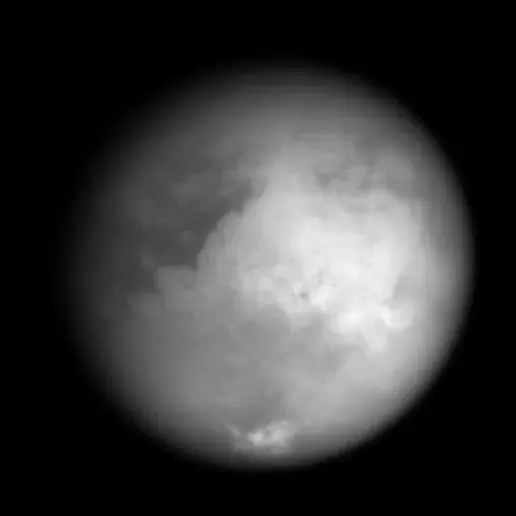
On October 26, 2004, NASA’s Cassini spacecraft captured the first high-resolution images of Saturn’s moon Titan, revealing a surface with features resembling early Earth. This close approach, occurring 300 times nearer than the previous flyby, provided critical atmospheric data for the subsequent Huygens lander mission.
Key points
- Cassini’s second flyby of Titan on October 26, 2004, reached a closest distance of 745 miles (1,200 kilometers) from the surface.
- The images revealed a continent-sized region named Xanadu, featuring bright areas suggesting mountain ranges, large basins, and smooth plains.
- The flyby data allowed scientists to measure Titan’s atmospheric density and composition, which was essential for planning the descent of the European Huygens probe.
- The Huygens lander successfully touched down on Titan in January 2005, following this initial reconnaissance.
- Cassini completed 127 close flybys of Titan during its 13-year mission at Saturn, which concluded in 2017.
Background
This event is part of a broader historical narrative regarding Saturn’s moons, including the 1671 discovery of Iapetus by Giovanni Cassini and the 1789 discovery of Mimas by William Herschel. Recent archive coverage has also highlighted how tidal forces and porous ice structures shape smaller Saturnian moons like Methone, contrasting with the complex surface geology revealed on Titan by the Cassini mission.
Why it matters
The 2004 flyby fundamentally changed the scientific understanding of Titan by providing the first detailed view of its surface, which appeared strikingly similar to a hypothesized young Earth. This data was crucial for validating the feasibility of the Huygens landing and laid the groundwork for understanding Titan’s unique atmospheric and geological processes.
What to watch
The Cassini mission continued its operations at Saturn until 2017, conducting further studies of Titan and other moons. The data collected from these flybys remains a primary resource for planetary scientists analyzing the evolution of icy worlds and pre-biotic environments in the solar system.
Want the full story? Read the original reporting
Read on Space