
Progress 96 Delivers Supplies and Robotic Control Gear to ISS
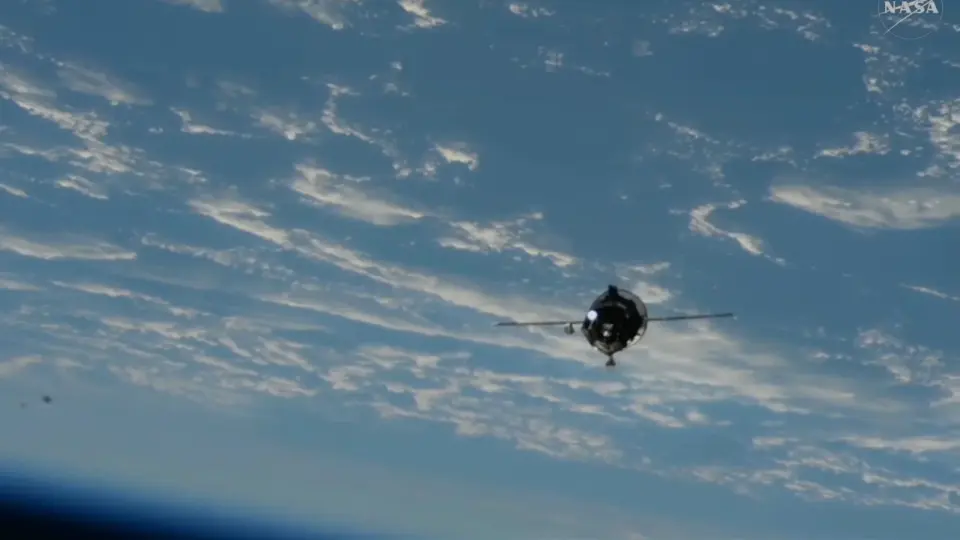
The Russian Progress 96 cargo spacecraft successfully docked with the International Space Station on September 19, 2026, delivering approximately three tons of supplies to the seven-member Expedition 75 crew. The mission, which launched from Baikonur Cosmodrome on September 16, included fuel, food, and scientific equipment, notably a control exoskeleton for the Teledroid robot. The spacecraft will remain docked for five months before re-entering Earth's atmosphere to dispose of waste.
Key points
- Progress 96 docked with the ISS Poisk module at 9:44 a.m. EDT on September 19, 2026.
- The spacecraft carried about 3 tons of cargo, including 842 kg of fuel, 420 kg of water, and 50 kg of compressed air.
- The payload included a special exoskeleton for remotely controlling the Teledroid humanoid robot, which is scheduled to arrive in November.
- The ISS currently houses seven crew members from NASA, Roscosmos, and the European Space Agency.
- Progress 96 will stay attached to the station for five months before a destructive re-entry to dispose of trash.
Background
This resupply mission follows a recent orbit-raising maneuver by Northrop Grumman's Cygnus XL, which adjusted the ISS trajectory to facilitate the Progress 96 approach. It also occurs amidst recent contract extensions for SpaceX crew flights, highlighting the ongoing international cooperation in maintaining the station despite geopolitical tensions on Earth.
How outlets are covering it
While Space.com and NASA confirmed the docking time and general cargo weight, Zamin.uz provided a detailed breakdown of the payload, specifying 842 kg of fuel and highlighting the Teledroid exoskeleton as a key technological innovation. SpaceQ Media focused on the broader context, noting that the Progress 96 arrival coincided with the quarantine period for the incoming Crew-13 mission, which includes Canadian astronaut Joshua Kutryk. All sources agree on the crew composition and the five-month docking duration, but Zamin.uz uniquely emphasized the scientific experiments and the future role of robotic repair systems in space exploration.
Why it matters
The successful delivery of the Teledroid control system marks a significant step toward automating maintenance tasks in space, potentially reducing the need for human spacewalks. This mission also underscores the continued reliance on Russian cargo vehicles for critical resupply, even as Western nations prepare for new crew rotations and long-term lunar and Mars exploration strategies.
What to watch
The Teledroid robot itself is scheduled to arrive at the ISS via a subsequent cargo mission in November 2026. Meanwhile, the Crew-13 mission, featuring Joshua Kutryk and three other astronauts, is targeted for launch in early October 2026, following their quarantine period at NASA's Johnson Space Center.
- Russian Progress spacecraft delivers 3 tons of cargo to the ISS (video) Space
- Progress 96 Cargo Spacecraft Docks to Station to Resupply Crew NASA (.gov)
- "Progress MS-35" is approaching the International Space Station: What awaits the 7 astronauts? Zamin.uz
- Weekly ISS update: New cargo ship launches to station as Crew-13 enters quarantine SpaceQ
- "Progress MS-35" docked with the ISS www1.ru
Want the full story? Read the original reporting
Read on Space