
ALMA Reveals Betelgeuse’s Boiling Surface and Persistent Anomalies
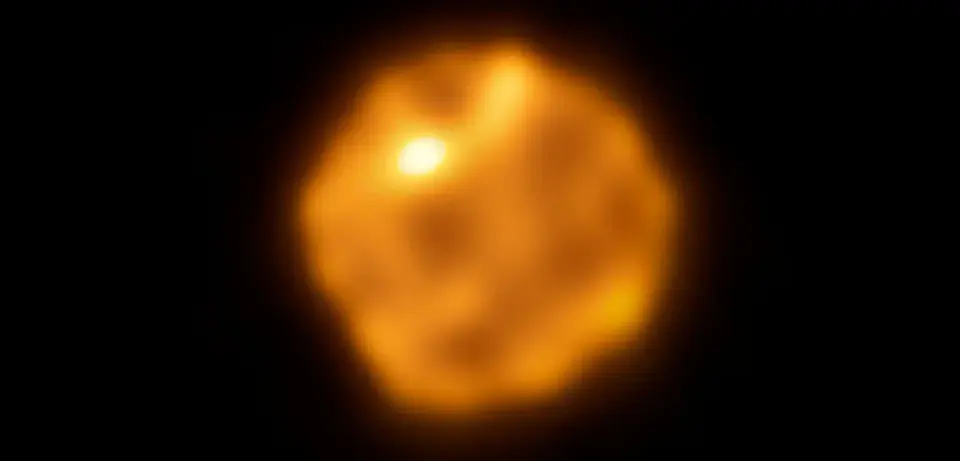
Astronomers have released the most detailed image of Betelgeuse’s surface to date, revealing a turbulent, boiling atmosphere with persistent hotspots. Simultaneously, new observations confirm the existence of a massive companion star, Betelgeuse B, which may influence the red supergiant’s eventual supernova.
Key points
- ALMA observations from 2023 show Betelgeuse’s surface has an average temperature of 2,300 Kelvin, with hotspots up to 800 Kelvin hotter than surrounding gas.
- A prominent northeastern hotspot has persisted in the same location for at least seven years, defying current models of convective feature lifespans.
- ESO’s VLT telescope captured the clearest image yet of Betelgeuse B, a companion star estimated to be two to three times the mass of the Sun.
- Betelgeuse’s radius varies by up to 6%, confirming it is not spherical, and its extended atmosphere reaches several stellar radii.
- The discovery of Betelgeuse B, more massive than predicted, may impact the star’s evolution and future supernova timing.
Background
Betelgeuse, a red supergiant in Orion approximately 600 light-years from Earth, has been a subject of intense study due to its proximity and impending supernova. Previous archive coverage from August 2026 highlighted the confirmation of Betelgeuse B as a binary companion, while July 2026 reports noted the initial detection of this companion. The current developments build on these findings by providing high-resolution surface data and confirming the companion’s mass and potential influence on the star’s stability.
How outlets are covering it
Futura-Sciences and BBC Sky at Night emphasize the unprecedented detail of ALMA’s 2023 observations, highlighting the 'boiling' nature of Betelgeuse’s surface and the surprising longevity of specific hotspots. Science Daily focuses on the confirmation of Betelgeuse B, noting that the companion is more massive than previously estimated, which could alter predictions about the star’s evolution. While Futura-Sciences and BBC link the persistent hotspots to convection, they note that the connection to the companion star is not yet established. Science Daily suggests the companion’s mass may influence the supernova timeline, a perspective not explicitly detailed in the other sources. All outlets agree that Betelgeuse is not currently on the verge of exploding, despite its bright appearance.
Why it matters
These findings provide critical insights into the final stages of a red supergiant’s life, helping astronomers refine models of stellar evolution and supernova prediction. The discovery of a massive companion star adds a new variable to Betelgeuse’s stability, potentially affecting its mass loss and atmospheric structure. Understanding these dynamics is essential for predicting when Betelgeuse will explode, an event that would be visible from Earth and could impact the solar system.
What to watch
Astronomers plan to conduct further high-resolution ALMA observations to track the persistent hotspots and determine if they are linked to the companion star. A follow-up observation of Betelgeuse B is scheduled for next year to confirm its orbital position and gravitational binding. Researchers will also investigate how the companion’s mass influences Betelgeuse’s evolution and supernova timing.
- Betelgeuse as you’ve never seen it: a boiling surface and a stunning anomaly Futura, le média qui explore le monde
- “I jumped from my chair” – Astronomers spot Betelgeuse’s hidden companion Science Daily
- The bubbling surface of doomed supergiant star Betelgeuse has been revealed like never before Space
- Science Snapshots: August 30, 2026 The Hindu
- Want to see a star in close-up? Astronomers have produced one of the most detailed images of Betelgeuse we've ever seen BBC Sky at Night Magazine
Want the full story? Read the original reporting
Read on Futura, le média qui explore le monde